HomeGlobal Equity

Equity Compliance in the United States: Rules, Tax and Deadlines

US equity compliance turns on the instrument. ISOs, NSOs and RSUs are taxed at different moments under two parallel systems, federal income tax and AMT, and the employer carries its own filing calendar. For companies that run US grants alongside grants in other countries, these rules are one layer of several.
Written by the
Slice Global equity team
Reviewed by the
Slice tax and compliance team
Last reviewed
August 2026
BROWSE

The US guides

GUIDE
How are stock options taxed?
Open guide  →
GUIDE
Granting options right: the 6 steps
Open guide  →
Employee stock option plan: the 8 clauses
Coming soon
ISO vs NSO, decided in one table
Coming soon
US equity reporting deadlines
Coming soon
RSU taxation in the US
Coming soon
Every US grant looks routine until the first employee asks a simple question: what do I actually keep if I exercise now? Finance opens the cap table, legal checks the 409A date, payroll guesses at withholding, and three systems give three different answers. The real answer depends on the instrument, because each one is taxed on a different schedule.
INSTRUMENTS

US equity instruments compared: ISO, NSO and RSU

ISO

employees only
Tax at grant
None
At vest
None
At exercise
None for regular federal income tax, but the spread counts for AMT
At sale
Long-term capital gains if held 2 years from grant and more than 1 year from exercise. A sale before both periods are met is a disqualifying disposition: the option spread is generally ordinary income, and any further gain is capital gain.
The honest limitation
The $100K rule does not cap vesting, it reclassifies. It measures the grant-date value of ISOs first exercisable in a calendar year, cumulative across every grant and plan, and the excess is treated as an NSO. Separately, the AMT can tax paper gains.
ISO
employees only
Tax at grant
None if strike is at fair market value
At vest
None
At exercise
Spread taxed as ordinary wages, withholding due
At sale
Capital gains on growth after exercise
The honest limitation
An ISO strike must sit at or above grant-date fair market value. An NSO can be struck lower, and Section 409A then bills the holder: income at vesting, a 20 percent additional federal tax and premium interest

NSO

anyone
Tax at grant
None if the strike is at or above fair market value
At vest
None
At exercise
Spread taxed as ordinary wages for an employee, withholding due
At sale
Capital gains on growth after exercise
The honest limitation
An NSO struck below fair market value can fall under Section 409A. If it does not comply, the holder can face income at vesting, a 20 percent additional federal tax and premium interest.

RSU

employees only
Tax at grant
None
At vest or delivery
Generally taxed as wages on full value when the shares are delivered, which can be later than vesting
At exercise
n/a
At sale
Capital gains on growth after delivery
The honest limitation
Tax can fall due whether or not the employee can sell. Selling shares to cover it works only where the shares can be sold, which is the hard part at private companies without liquidity.
ESSP
section 423
Tax at grant
None
At vest
None
At exercise
None at purchase in a qualified plan
At sale
Ordinary income on the discount plus capital gains, holding periods decide the split
The honest limitation
The statutory annual purchase cap and the disposition rules confuse payroll teams everywhere. Slice does not support ESPP; a qualified plan needs its own tooling.
PRACTICE NOTE
Sequence exercises against the 409A cycle. The AMT spread and the QSBS basis both key off the fair market value on the exercise date, so in a growing company the same exercise gets more expensive every valuation refresh. When an employee is going to exercise anyway, earlier in the cycle is almost always cheaper.

The 83(b) clock: 30 days.
No extensions.

An 83(b) election applies when stock is transferred while subject to a substantial risk of forfeiture, such as restricted stock or early-exercised options. It does not apply to an ordinary option grant or an ordinary RSU. The election moves the tax moment to the stock transfer. It must be filed with the IRS within 30 days of that transfer, which means the early-exercise or restricted-stock purchase date, not the option grant date. The 30 days cannot be extended. If day 30 falls on a weekend or legal holiday, the deadline is the next business day.

For restricted stock and early-exercised NSOs, without a timely election the tax falls at vesting, on whatever the shares are worth then. Early-exercised ISOs follow separate rules. The employee files the election. The election document belongs in the grant record, alongside the grant letter.
QSBS

QSBS and option exercises

An option is not itself qualified small business stock (QSBS). Stock acquired at exercise can qualify, but the company and the shares must meet the Section 1202 requirements. For an option holder, the stock is issued at exercise, not at grant, so exercise timing is a QSBS decision as well as a cash decision. The holding period alone does not establish eligibility.
Issued on or before July 4, 2025
Issued after July 4, 2025
Exclusion
100 percent after 5 years, nothing earlier
50 percent at 3 years, 75 percent at 4, 100 percent at 5
Gain cap
10 million dollars or 10x basis
15 million dollars, indexed, or 10x basis
Company asset test
50 million dollars gross assets
75 million dollars gross assets
Exclusion
Issued on or before July 4, 2025
100 percent after 5 years, nothing earlier
Issued after July 4, 2025
50 percent at 3 years, 75 percent at 4, 100 percent at 5
Gain cap
Issued on or before July 4, 2025
10 million dollars or 10x basis
Issued after July 4, 2025
15 million dollars, indexed, or 10x basis
Company asset test
Issued on or before July 4, 2025
50 million dollars gross assets
Issued after July 4, 2025
75 million dollars gross assets
AMT

AMT and ISO exercises

The AMT is the parallel tax system that recalculates income with fewer breaks. An ISO exercise adds the exercise-date spread to AMT income, even when no shares are sold. Whether the employee owes AMT depends on the full calculation for that tax year, not on the spread alone. Model the exercise under the rules for the year it will happen in.
FILING CALENDAR

US employer equity filing calendar

The table shows nominal deadlines in the calendar year after the exercise or transfer. Confirm the dates for the filing season, including weekend and legal-holiday adjustments.
Form
What it reports
To employees
To the IRS
Form 3921
Every ISO exercise in the year
JAN 31
FEB 28
paper
MAR 31
e-file
W-2
NSO spread and RSU income in wages, code V for NSOs, ISO disqualifying dispositions
JAN 31
JAN 31
Form 3921
What it reports
Every ISO exercise in the year
To employees
JAN 31
To the IRS
FEB 28
paper
MAR 31
e-file
Form 3922
What it reports
ESPP first transfers
To employees
JAN 31
To the IRS
FEB 28
paper
MAR 31
e-file
W-2
What it reports
NSO spread and RSU income in wages, code V for NSOs, ISO disqualifying dispositions
To employees
JAN 31
To the IRS
JAN 31
E-filing is mandatory at 10 or more information returns in aggregate, and W-2s count toward that total. Late-filing penalties apply per form, and 200 ISO exercises means 200 forms.
GRANTING STEPS

Granting equity in the US, step by step

1
Board approves the plan and share reserve.
The plan document sets the rules every grant inherits.
2
Get a 409A valuation.
An ISO strike must sit at or above grant-date fair market value, 110 percent of it for a holder of more than 10 percent of the company's voting power. The safe harbor is an independent appraisal, presumed reasonable for 12 months or until information arrives that materially affects value, whichever comes first.
3
Grant under the plan, with board consent per grant.
A frequent paper-trail gap in diligence. Slice sends board approvals for signature through DocuSign and collects them, and offline approvals can be recorded without an envelope.
4
Check the securities exemption.
Rule 701 for private companies: securities sold under the rule in any 12 months are capped at the greatest of $1 million, 15 percent of assets, or 15 percent of the class. If sales in reliance on Rule 701 in that period are expected to exceed $10 million, the required enhanced disclosure goes to all recipients in the period, a reasonable time before exercise or sale.
5
On exercise: collect, withhold where it applies, start the clocks.
Exercise price in. Withholding out for an employee's NSO. The QSBS holding period starts at exercise for stock that qualifies.
6
File what applies from the calendar above, each filing season.
Form 3921 for ISO exercises, W-2 for wages.

Where Slice fits

Slice is the AI-native global equity management platform for finance and legal teams that grant equity across borders, built for private companies that offer equity to employees and stakeholders. US grants sit in the same system as grants in 66+ countries, so a company running ISOs and NSOs in the US alongside awards elsewhere works from one record. For US grants, Slice calculates the $100K ISO/NSO split automatically at grant and prepares Form 3921 data for filing outside the platform. When an employee moves countries, HRIS sync proposes the change for admin review and the equity record follows.
FAQ

Frequently asked questions

How is equity compensation taxed in the United States?

US federal tax on equity depends on the instrument, and each one is taxed at a different moment:

‍

  • ISO: no regular federal income tax at exercise, but the spread counts for AMT.
  • NSO: the spread at exercise is taxed as ordinary wages for an employee, with withholding.
  • RSU: the full share value is generally taxed as wages when the shares are delivered.

Growth after those moments is generally capital gain at sale.

What is the difference between an ISO and an NSO?

An ISO can go only to employees and carries no regular federal income tax at exercise, though the spread counts for AMT. An NSO can go to anyone, and the spread at exercise is ordinary income. ISO shares held 2 years from grant and more than 1 year from exercise can qualify for long-term capital gains treatment at sale.

Can contractors receive ISOs?

No. ISOs are limited to employees. Contractors, advisors and board members receive NSOs. A contractor's NSO exercise generally carries no payroll withholding, and the income may need to be reported on Form 1099-NEC.

What is the $100K ISO limit?

The $100K limit caps the ISOs that can first become exercisable in one calendar year at $100,000 of grant-date fair market value. It is cumulative across every grant and plan. It does not cap vesting: the excess is treated as an NSO. Slice calculates the ISO/NSO split automatically at grant.

What is the deadline for an 83(b) election?

An 83(b) election must be filed with the IRS within 30 days of the stock transfer. That is the early-exercise or restricted-stock purchase date, not the option grant date. There is no extension. If day 30 falls on a weekend or legal holiday, the deadline is the next business day.

How long is a 409A valuation valid?

A 409A valuation supports the safe harbor for up to 12 months. An independent appraisal is presumed reasonable for 12 months or until information arrives that materially affects value, whichever comes first. A financing round, a tender offer or a pending acquisition can end it earlier.

When is Form 3921 due?

The nominal Form 3921 deadlines fall in the year after the ISO exercise:

‍

  • Employee copy: January 31.
  • IRS paper filing: February 28.
  • IRS e-file: March 31.

Confirm the adjusted dates for the filing season. E-filing is mandatory at 10 or more information returns in aggregate, and W-2s count toward that total.

How does Slice handle Form 3921?

Slice prepares Form 3921 data for filing outside the platform, and reports can be locked as point-in-time audit snapshots.
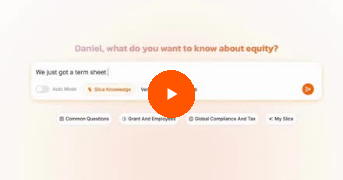
Ask SliceAI
Put the hard equity questions to SliceAI and get a sourced answer from your own data, not a public chatbot's guess.
book a demo

Stop stitching five systems to answer one question.

Slice is the system of record for your equity, legal and ownership data across 66+ countries. Ask SliceAI and get a sourced answer from that data.
Book a demo