HomeGlobal EquityUnited States

AMT and Stock Options: The Tax Nobody Withholds

Stock options meet the alternative minimum tax principally at the ISO exercise. For vested shares held past the exercise year, the spread between exercise-date fair market value and the strike counts as income for AMT while regular tax sees nothing, and no employer withholding covers it.
Written by the
Slice Global equity team
Last updated
October 2026
The question always arrives with a deadline attached: an employee has 90 days left to exercise after leaving, or a tender offer closes Friday, and they want to know what the tax will be. The honest answer depends on two letters in the grant agreement. ISOs and NSOs look interchangeable in an offer letter and behave nothing alike at tax time, so everything below starts at that fork.
TL;DR
The short version, by stage.
The trigger: the ISO exercise is the option event that creates an AMT adjustment. For vested shares held past the exercise year, the spread counts as AMT income while regular tax sees nothing at exercise. NSO spreads are ordinary income in both systems, so they are not an AMT event. A qualifying ISO sale can bring its own exposure later.
The 2026 numbers: exemptions of $90,100 single and $140,200 joint, phasing out at 50 cents per dollar of AMTI above $500,000 and $1,000,000, and gone entirely at $680,200 and $1,280,400. Above the exemption the tax runs at 26 and 28 percent.
No withholding: an ISO exercise carries no income-tax withholding and no FICA. The company's artifact is Form 3921; any AMT lands on the holder's return alone.
The way back: AMT paid on the ISO adjustment can generate the minimum tax credit, claimed on Form 8801 and carried forward against regular tax in later years.
In March the finance inbox gets the message every equity admin eventually gets. An employee exercised ISOs the previous June, the paystub never changed, and their accountant has just introduced them to the letters AMTI. Now they want to know why nothing was withheld, and whether payroll made a mistake. It did not: ISO exercises carry no withholding, and any AMT liability is determined on the holder's return, not the paycheck.

That conversation is the whole subject. This guide covers what the AMT is, when stock options trigger it, the 2026 numbers that decide who actually pays, how many options can be exercised before it starts, why no withholding stands behind the bill, the credit that brings much of it back, and the sale-year wrinkle that catches even long-term holders.

What is the alternative minimum tax?
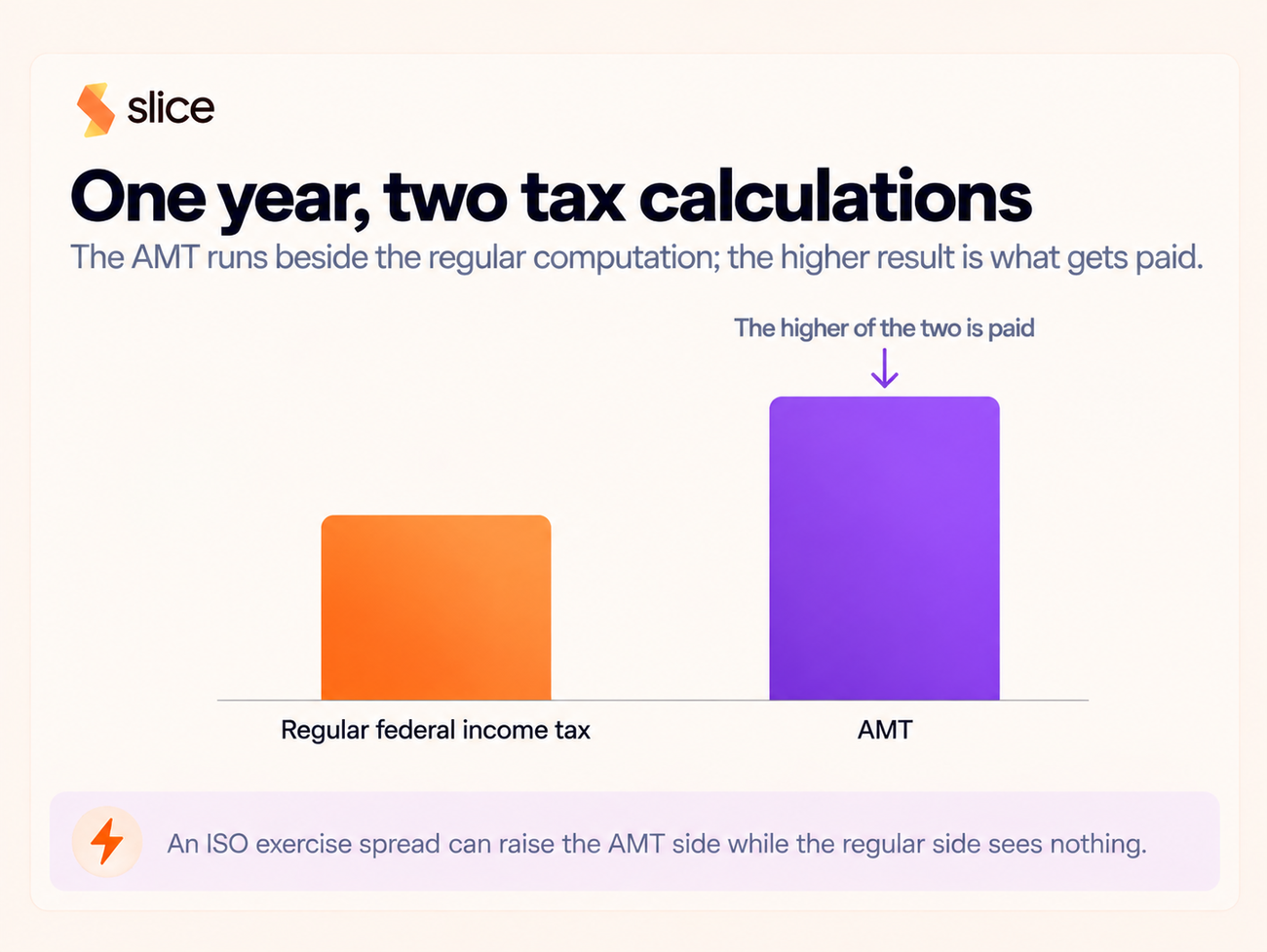
The alternative minimum tax is a second federal income tax computation run beside the regular one. The filer's year is worked out twice, once under each set of rules, and the higher result is what gets paid. The AMT disallows some deductions and counts some income the regular system ignores; the ISO exercise spread is the equity item it counts. The two computations side by side:

When stock options trigger the AMT

The alternative minimum tax's option-side adjustment comes from one pattern: exercising an ISO on vested shares and holding them past the end of the exercise year. For AMT purposes, the spread between the exercise-date fair market value and the strike is income, even though the regular income tax recognizes nothing at that moment. One exercise, two parallel tax systems, two different answers.

It is the main AMT moment for options, though not the only one; a qualifying sale can bring its own exposure, covered below. And a sale in the exercise year itself is a disqualifying disposition, with that year's income determined under the applicable disposition rules, and the AMT framing in this guide is for shares still held at year end.

One boundary on the measurement itself: it assumes vested shares. Where exercised shares are both nontransferable and still subject to a substantial risk of forfeiture, the AMT adjustment arises when the shares become transferable or the risk lapses, whichever happens first, measured at that date's fair market value, which can differ from exercise-day value.

A timely Section 83(b) election can instead bring the AMT measurement forward to the exercise. Early-exercise plans live in this territory; the 83(b) guide covers it.

NSOs never enter this lane. An NSO spread is ordinary income in both systems at exercise, with withholding behind it, so there is no AMT adjustment to make. The AMT question is an ISO question.

One structure needs separate treatment: the net exercise. Where the option's original terms permitted it from grant, the generally accepted treatment splits the shares two ways:
  • The withheld shares: a deemed disqualifying disposition, with ordinary income on them.
  • The remaining shares: they stay ISOs and their spread stays in the AMT lane.
The rules do not specifically address the structure, so this is accepted practice rather than statute, and the two halves should not be collapsed into one treatment. Adding the mechanic to an option later is a change to its terms, with tax consequences of its own.

The instrument decides whether the AMT is even in the room:
Instrument
AMT-only adjustment at exercise or settlement?
Regular-tax income at that moment
ISO
Yes, for vested shares held past the exercise year: the spread is AMT income
None at exercise
NSO
No
The spread is ordinary income (supplemental wages) at exercise
RSU
No
Ordinary income when the shares are paid out

The 2026 AMT numbers: exemption, phase-out and rates
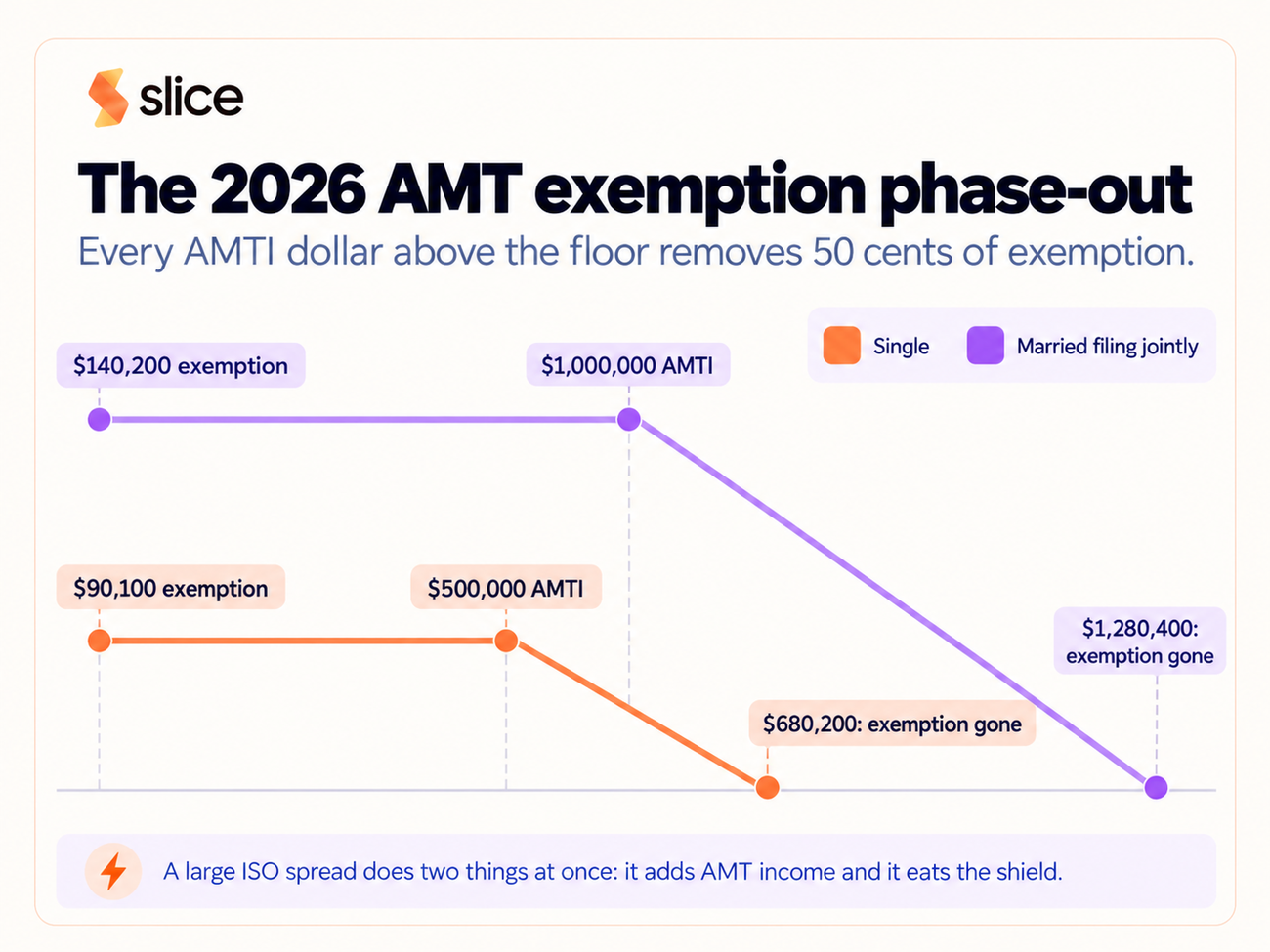
Whether an ISO spread becomes an AMT bill runs through the exemption, and the exemption shrinks as income rises: every dollar of AMTI above the phase-out floor removes 50 cents of exemption. A large spread therefore does two things at once. It adds AMT income, and it eats the shield that would have absorbed it.
Single
Married filing jointly
Married filing separately
Exemption
$90,100
$140,200
$70,100
Phase-out begins at AMTI of
$500,000
$1,000,000 (frozen through 2026)
$500,000
Exemption fully gone at
$680,200
$1,280,400
$640,200
Both phase-outs on one slope, from the floor to the gone point:
Above the exemption, the tax itself has two rates: 26 percent and 28 percent. The 28 percent rate applies above $244,500 of taxable excess, $122,250 for a separate filer, a breakpoint measured on the excess above the exemption, not on AMTI.

The computation happens on Form 6251, where the ISO adjustment enters at line 2i: the shares' value when first transferable or no longer at risk of forfeiture, over the amount paid.

These are the figures that make exercise timing a real decision: the same spread that slides under the exemption in a quiet year can land fully exposed in a year that already carries a bonus, a sale, or a second income.

How many ISOs can be exercised before the AMT starts

There is no universal number of ISOs that can be exercised without additional AMT. The effect of an ISO adjustment depends on the holder's full-year regular-tax and AMT calculations:
  • For a holder not otherwise in AMT, room exists until the tentative minimum tax computed on Form 6251 passes the year's regular tax.
  • For a holder already subject to AMT, additional ISO spread can increase the AMT owed.
Where that point sits depends on the whole return: ordinary income, filing status, deductions, the exemption phase-out, and the spread itself. The calculation is annual, which is why the planning question is how many options this year, not whether ever to exercise; credits from earlier years run on their own Form 8801 track.

Slice's Equity Value Simulator can estimate the tax impact of an ISO exercise, including AMT; its estimates are informational, not tax advice.

The ISO exercise has no withholding behind it

An ISO exercise carries no income-tax withholding and no FICA. The paystub does not move, the W-2 shows nothing for a qualifying path, and the information return behind the event is Form 3921, which the company prepares for every ISO share transfer, carrying the exercise date, the fair market value and the strike: for vested shares, the exact inputs of the AMT spread.

Which is why the AMT surprise often becomes a conversation for the company, even though the tax is the holder's. Nobody at the company made an error when nothing was withheld, and the company still ends up explaining that in March. Companies that share the current valuation before holders exercise are far better placed to avoid that conversation.

The withholding gap has a quarterly edge too: with nothing collected on the spread, a large exercise can leave the year's payments behind the Form 1040-ES safe harbors. Estimated payments generally enter when the balance after withholding will reach at least $1,000 and payments miss the safe-harbor percentages:
  • 90 percent of current-year tax, or
  • 100 to 110 percent of prior-year tax by income level.
The thresholds run on the whole return, not the spread by itself.

Practice note. From our experience, communicate the current fair market value to holders through the year, not only at grant. For vested shares, the AMT spread is measured on exercise-day FMV, and a holder who knows the number before choosing the date has the one input that makes the decision a decision.

Warning: for vested shares held past the exercise year, the AMT spread locks at exercise. The exercise date fixes the fair market value behind the AMT spread, and no later price movement rewrites it. An exercise made at a high valuation keeps that spread for AMT purposes even if the valuation falls afterward. The date cannot be re-run.

The minimum tax credit: how AMT paid on ISOs can come back

AMT paid because of an ISO exercise is often a timing cost rather than a permanent one. The ISO adjustment is a deferral item, and AMT attributable to deferral items can generate the minimum tax credit under Section 53, claimed on Form 8801. The credit carries forward and offsets regular tax in later years, in years when regular tax exceeds the tentative minimum.

The exercise also leaves the shares with two cost bases: the regular basis at the strike, and a higher AMT basis that includes the amount already taken into AMT income. That dual basis shrinks the AMT-side gain when the shares are eventually sold. Recovering the credit takes returns and years, not a form and a week, and how much comes back depends on the holder's later tax picture.

The credit runs on a three-stage clock:
Stage
What happens
Form
Exercise year
The ISO spread raises AMTI; AMT is owed only if the tentative minimum tax exceeds the regular tax
Form 6251
Later years
AMT attributable to deferral items, the ISO adjustment among them, may generate a minimum tax credit; unused credit carries forward, usable when regular tax exceeds the tentative minimum
Form 8801
Sale year
The higher AMT basis shrinks the AMT-side gain; any credit usable in the sale year depends on that year's Form 8801 calculation
Form 8801

Qualifying ISO sales can trigger AMT too

A holder who clears both ISO holding periods and sells expects long-term capital gains and a closed story. But a large qualifying sale can itself create AMT exposure in a high-income year: taxable gain can raise AMTI into the phase-out, and every dollar above the floor takes 50 cents of exemption with it.

The dual AMT basis from the exercise shrinks that exposure, but it does not always eliminate it, and under the 2026 phase-out mechanics the effect is especially live. The sale year deserves the same calculation the exercise year got. Patience changes the character of the gain; it does not switch the AMT off.

Where Slice fits

The AMT conversation runs on two pieces of data the company controls: the exercise record and the valuation behind it. Exercises in Slice carry their dates and amounts as data, the "Form 3921 - Exercises of Incentive Stock Options" report at Compliance → Reports prepares the per-transfer figures for filing outside the platform, and compliance alerts raise automatically from the equity data, valuations included.

The Equity Value Simulator estimates tax outcomes for planning, informational only, not tax advice. You enter or approve the facts; nothing files with regulators automatically.
What softens the AMT hit
Three mechanics.
  • Selling in the same tax year collapses the AMT adjustment on the shares actually sold.
  • AMT actually paid on a spread becomes a minimum tax credit, claimable against regular tax in later years on Form 8801.
  • The shares carry a higher AMT basis than their regular-tax basis, which shrinks the AMT gain when they are eventually sold.
The mistake is treating the whole exercise as disqualified because part of it was sold.
PRACTICE NOTE
The 22 percent flat rate is fixed by regulation. An employer cannot dial it up, and it covers federal income tax only: Social Security and Medicare still apply on top and cannot be waived. What an employer can run instead is the aggregate method. What an employee can do is file a W-4 with additional withholding, which beats a late estimated payment because withholding counts as paid evenly across the year.

From our experience, the failures are never exotic. They are a 3921 nobody e-filed because the person who exercised had already left, or a withholding miss on a sell-to-cover that settled across a year boundary. Boring, dated, expensive.
FAQ

Frequently asked questions

Do stock options trigger the alternative minimum tax?

Only ISOs. Exercising an ISO on vested shares and holding them past the exercise year creates an AMT adjustment equal to the spread between exercise-date fair market value and the strike, while regular tax recognizes nothing at that moment.

NSO spreads are ordinary income in both systems at exercise, so an NSO is not an AMT event, and a later qualifying sale can bring its own exposure; the full picture sits in how stock options are taxed.

What are the AMT exemption amounts for 2026?

The 2026 figures:

  • Exemption: $90,100 single, $140,200 married filing jointly, $70,100 married filing separately.
  • Phase-out: begins at $500,000 AMTI single and separate, $1,000,000 joint, at 50 cents of exemption per dollar above the floor.
  • Fully gone: $680,200 single, $1,280,400 joint, $640,200 separate.

Is AMT withheld when an employee exercises ISOs?

No. An ISO exercise carries no income-tax withholding and no FICA, so nothing on the paystub reflects it. The company's reporting artifact is Form 3921, one per share transfer, and any AMT is computed and paid on the holder's own return. How the grant side is papered lives in how to grant stock options right.

Does AMT paid on ISO exercises come back?

Often, yes, through the minimum tax credit. The ISO adjustment is a deferral item, and AMT paid on deferral items can generate the Section 53 credit, claimed on Form 8801, carried forward, and usable in later years when regular tax exceeds the tentative minimum; how much returns depends on those years. The shares also keep a higher AMT basis, which shrinks the AMT-side gain at sale.

Can a qualifying ISO sale still cause AMT?

Yes. The taxable gain on a large qualifying sale can raise AMTI, and AMTI above the phase-out floor removes exemption at 50 cents per dollar, so the sale year can carry its own AMT exposure. The dual AMT basis from the exercise reduces it but does not always eliminate it. The sale year deserves its own calculation.

Do RSUs trigger the alternative minimum tax?

No. An RSU settlement is ordinary income under the regular federal system in the year the shares are paid out, so there is no AMT-only spread to add back; the exercise-time adjustment is specific to incentive stock options.

Does the alternative minimum tax still exist in 2026?

Yes. The individual AMT is permanent law: the 2025 reform (OBBBA) kept the larger exemptions and tightened the phase-out, so a large ISO exercise can still reach it. The 2026 thresholds sit in the table above.

Table of contents
Ask SliceAI
Put the hard equity questions to SliceAI and get a sourced answer from your own data, not a public chatbot's guess.
book a demo

Stop stitching five systems to answer one question.

Slice is the system of record for your equity, legal and ownership data across 66+ countries. Ask SliceAI and get a sourced answer from that data.
Book a demo