


Never let an 83(b) deadline slip past your team
Slice flags every grant that may need an 83(b) election the moment restricted stock is issued or options are early exercised, then tracks the 30-day deadline for your team.
get a Demo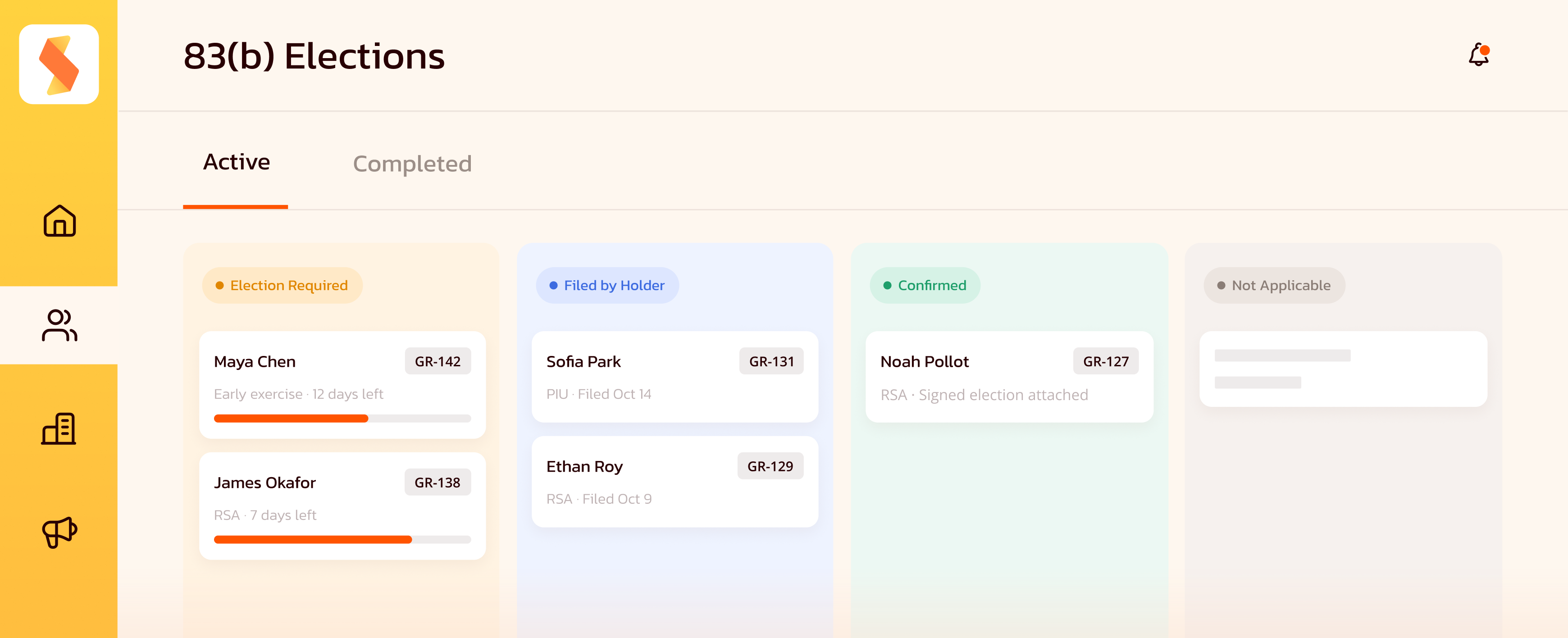


Companies protect their teams from surprise tax bills with Slice





AUTOMATIC DETECTION
Know instantly which grants need an 83(b) election
When you issue restricted stock or profits interest units, Slice identifies the grant as 83(b)-eligible and alerts your team right away. For grants that allow early exercise, Slice flags the 83(b) election the moment a holder exercises unvested options, so the 30-day clock never starts without anyone knowing.


DEADLINE TRACKING
Track every 30-day deadline in one place
The IRS window is 30 days from the date of transfer, with no extensions. Every 83(b) alert carries its due date, appears in your time-sensitive alerts, and lands in your team's compliance digest email before it's due.
MULTI-COUNTRY COMPLIANCE
Apply 83(b) only where it belongs
The 83(b) election is a US tax filing. Slice uses each holder's tax residency history to apply it only to US taxpayers, while every other holder's grant is checked against the rules of their own country.


CENTRAL RECORDS
Keep every election linked to its grant
Signed elections and filing confirmations are stored with the grant and can be shared with the holder in their Slice app, ready for due diligence, audits, and future tax questions.


OTHER FEATURES
FAQ
What is an 83(b) election, and when might someone consider one?
An 83(b) election lets a recipient of substantially nonvested property choose to recognize its value for US tax purposes when the property is transferred rather than generally when it vests. It may be relevant to founders or employees receiving restricted stock, or to someone who acquires unvested shares by exercising an option early. An option grant alone does not start the election period.
- Deadline: The recipient must file with the IRS within 30 days after the property transfer.
- Tax decision: Compare the property’s value at transfer with the amount paid, and consider the risk of paying tax on shares that are later forfeited. Tax paid because of an election generally cannot be recovered simply because the shares are forfeited.
How should multinational companies approach 83(b) elections for relocating employees?
A move does not restart the 30-day period, which runs from the property transfer. For each potentially relevant transfer:
- Assess the employee’s US tax position and work history to determine potential US tax exposure.
- Evaluate taxation and reporting in other relevant countries separately; a US election does not determine the treatment elsewhere.
How can Slice help identify potential 83(b) election opportunities?
Slice surfaces informational compliance reminders for certain recorded US restricted-stock awards and early option exercises. These reminders can help teams identify a possible election opportunity and its 30-day filing window. They do not determine whether an election is available or beneficial for a particular holder, and an 83(b) election is optional.
How can Slice help teams manage 83(b) deadlines and records?
Slice’s compliance alerts can help administrators review potential filing windows, and equity records can help them retain related documentation. The recipient remains responsible for deciding whether to elect and filing on time.


