The question always arrives with a deadline attached: an employee has 90 days left to exercise after leaving, or a tender offer closes Friday, and they want to know what the tax will be. The honest answer depends on two letters in the grant agreement. ISOs and NSOs look interchangeable in an offer letter and behave nothing alike at tax time, so everything below starts at that fork.
TL;DR
The short version, by stage.
What it does: shifts the tax moment for restricted stock from each vesting date to the transfer date, so later appreciation is treated under the capital gains rules instead of landing in the wage base as the shares vest.
The deadline: 30 days from the stock transfer date, meaning the early-exercise or restricted-stock purchase date. Not the grant date, not the vesting dates. A day 30 that lands on a weekend or holiday moves to the next business day. There is no late election.
How to file: Form 15620, which the IRS has accepted electronically since late 2024, or a compliant statement. A copy belongs in the company's grant record.
The gamble: the election is irrevocable, and tax paid on shares the holder later forfeits is not refunded. In the common early-exercise case, the strike equals fair market value, the included amount is zero, and the election costs nothing to file.
Two early hires at the same startup early-exercise their options in the same week, at a strike equal to that day's fair market value. The first one files a one-page election with the exercise papers. The second means to get to it, and week four arrives before the envelope does. Years later they sell the same shares on the same day, and their tax lives look nothing alike: the first settled everything on day one at a spread of zero, the second was taxed as the shares vested, on each vesting date's value, before the sale ever happened.
One page of paper, thirty days, and no way back. This guide covers what the election actually changes, how the deadline is counted, how to file since Form 15620 went electronic, who can and cannot elect, what filing risks, and what the election does to the clocks that run after it.
What an 83(b) election does
Restricted stock, shares the holder owns but can still forfeit, is taxed by default as it vests: each vesting date, the fair market value that day minus the price paid lands as ordinary income. In a company whose value is climbing, that means bigger tax on every vest date, on paper that cannot be sold.
A timely 83(b) election replaces all of that with one event. The holder is taxed at transfer, on that day's value minus the price paid, and the vesting dates stop being tax events entirely.
Fair market value at each vest, minus the price paid
Fair market value at transfer, minus the price paid
Ordinary income up to each vest; capital treatment only after
Capital gain or loss, under the otherwise applicable rules
The honest limitation: the election is irrevocable, and it is a bet on the shares vesting and the value holding. Both sides of that bet are covered below.
The 83(b) deadline: 30 days from stock transfer
The clock runs from the stock transfer date. For an early-exercise plan, that is the exercise itself. For founder stock, the purchase date. Not the grant date, not the vesting schedule, not the day the paperwork was signed if the shares moved earlier.
Warning: the 83(b) window has no cure. Thirty days from the stock transfer date. Form 15620 or a compliant statement. If day 30 falls on a weekend or a holiday, the next business day works. Miss it and there is no late election, no extension and no fix. The tax outcome is set.
That window sits inside a longer sequence. Grant to sale, with the two side rules that run on their own clocks:
How to file an 83(b) election: Form 15620
Since late 2024 the IRS accepts the election electronically on Form 15620, which removed the lost-mail excuse. Filing on paper with proof of mailing still works, and so does a statement carrying the required elements. The steps the holder takes:
- Complete Form 15620 or a compliant election statement.
- File it within 30 days of the stock transfer: electronically on Form 15620, or by mail with proof of the postmark date.
- Give a copy to the company. The election document belongs in the grant record, alongside the grant letter.
- Keep proof of filing for as long as the shares are held.
Most guides to this election still describe the mail-only world. If the article you are reading treats certified mail as the only safe route, check its date: the electronic option has existed since late 2024.
Practice note. The election belongs with the exercise papers, not after them. The 83(b) packet travels in the same email as the grant documents, and treating it as page one of the exercise, instead of a follow-up task, is what keeps week four from arriving first. Thirty days feel long in week one and short in week four.
Who can file an 83(b) election, and who cannot
The election attaches to stock that has been transferred and can still be forfeited. That single sentence decides every case:
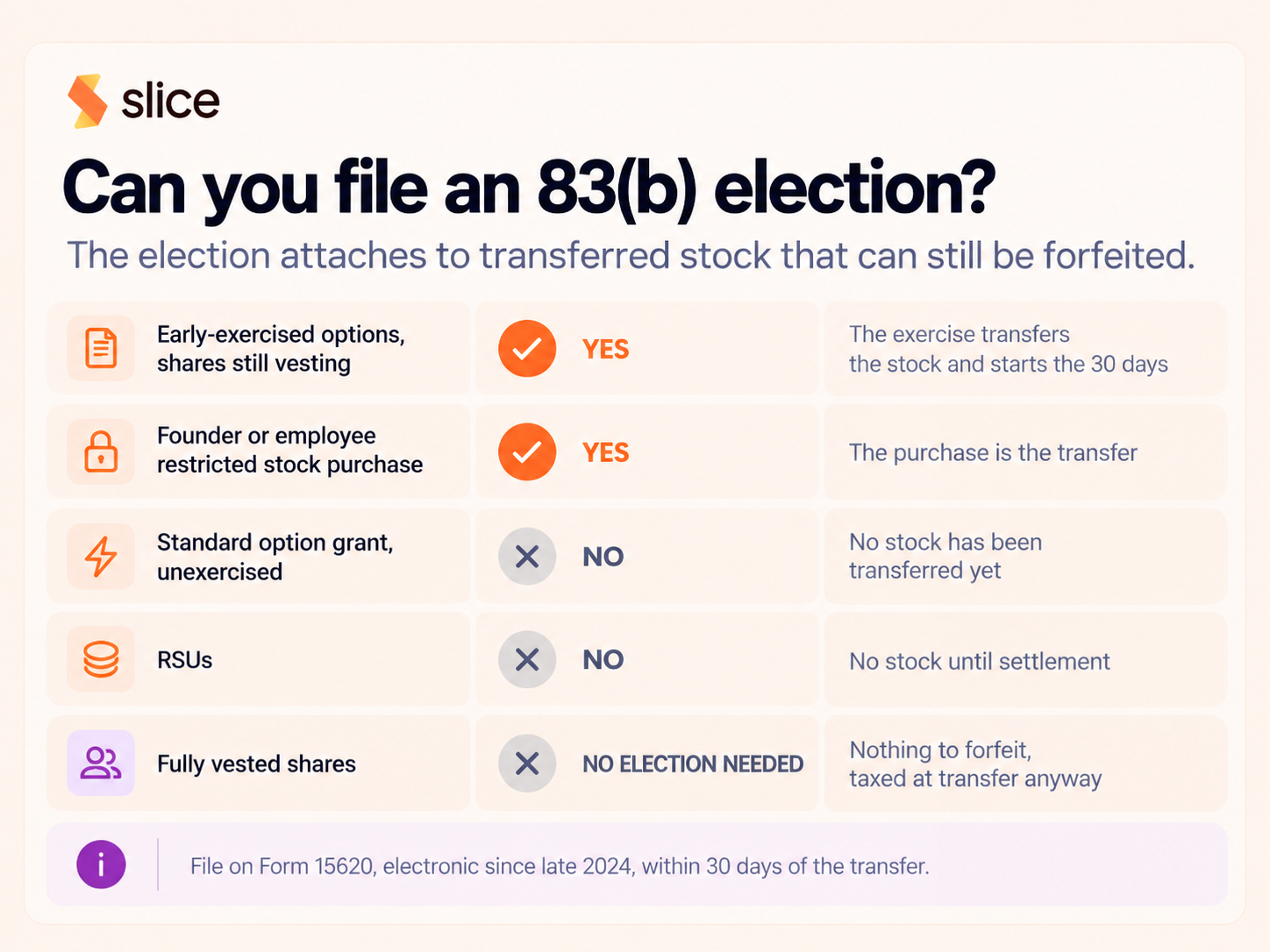
The same five cases, with the reasoning in full:
Early-exercised options, shares still vesting
Yes. The exercise transfers the stock and starts the 30 days
Founder or employee restricted stock purchase
Yes. The purchase is the transfer
A standard option grant, unexercised
No. No stock has been transferred, so there is nothing to elect on. The window opens only if and when an early exercise happens
No. No stock is transferred until settlement, so there is nothing to elect on
No election needed. Nothing can be forfeited, so the stock is taxed at transfer anyway
The 83(b) gamble: what filing risks
The election is a bet with two ways to lose. If the holder leaves before vesting and forfeits the shares, the tax paid on the included amount is not refunded, and the amount is not deductible. If the value falls, the holder paid tax on a price the shares never see again.
Which is why the common early-exercise case is the interesting one. An early exercise at a strike equal to grant-date fair market value has a spread of zero, so the election reports zero income. Filing costs nothing at the moment of filing. Skipping it hands every dollar of later appreciation to the vesting dates, as ordinary income, on shares that still cannot be sold.
83(b) and the clocks that run after it
The election also decides when the capital gains holding period starts. With a timely 83(b), the holding period runs from the transfer. Without one, it runs from each vesting date, share by share.
Every clock that measures from acquisition inherits that answer, including the QSBS holding period, where the difference between counting from a single early-exercise date and counting from a string of vesting dates can be the difference between tiers. The two-regime mechanics live in the
QSBS exclusion guide; what matters here is that the 83(b) decision is made years before those clocks are read, inside a 30 day window that does not wait.
Where Slice fits
The election lives or dies on two documents existing in the right place: the filed election and the exercise record that dates it. Early exercises run through Slice's
exercise workflow, so the transfer date that starts the 30 days exists as data, and the grant packet that Slice generates and routes through DocuSign is where the 83(b) papers travel with the exercise documents. The employee files the election; the copy belongs in the grant record, alongside the grant letter. Nothing files with regulators automatically.
FAQ
Frequently asked questions
What is an 83(b) election?
An election under Section 83(b) of the Internal Revenue Code to be taxed on restricted stock at transfer, on that day's value minus the price paid, instead of at each vesting date on the then-current value. It moves the tax moment earlier and starts the capital gains holding period at transfer.
When is the 83(b) deadline?
30 days from the stock transfer date. Counting rules:
- The transfer date is the early-exercise or restricted-stock purchase date, not the grant date and not a vesting date.
- If day 30 falls on a weekend or holiday, the next business day works.
- There is no extension and no late election.
Can an 83(b) election be filed late?
No. The 30 day window has no cure: no late election, no extension, no relief for a missed deadline. If the window has closed, the default rules apply and the shares are taxed as they vest, covered in how stock options are taxed.
Can an 83(b) election be filed for RSUs?
No. An RSU transfers no stock until settlement, and the election attaches to transferred stock, so there is nothing to elect on. RSUs are taxed as wages when they settle, part of the employer picture in US equity compliance.
Does a standard stock option need an 83(b) election?
Not for the option itself. A standard option grant transfers no stock, so there is nothing to elect on and no deadline running. The election becomes relevant at early exercise: the exercise transfers still-vesting shares and opens the 30 day window. How the grant itself is papered is covered in how to grant stock options right.