The QSBS Exclusion: Two Sets of Rules, Split by One Date

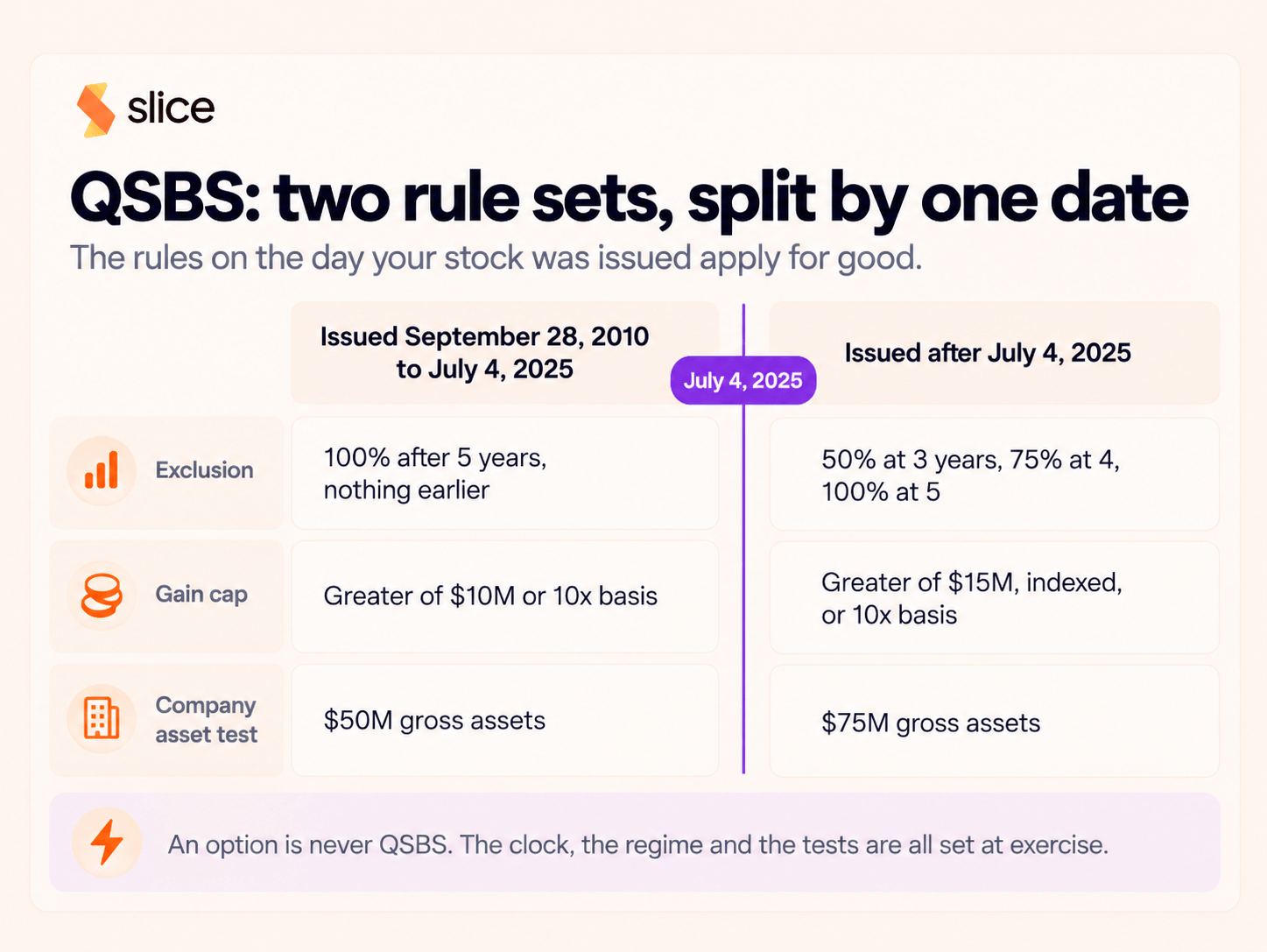
That photograph is the whole subject. The July 2025 rewrite of Section 1202 split QSBS into two rule sets, and one date decides which set each share lives under. This guide runs in the order the question reaches a finance team: what the exclusion is, which regime each share sits under, why an option holder's story starts at exercise rather than grant, what the company has to be and keep being, and what evidence will carry the claim years from now.
What qualifies as QSBS under Section 1202
That definition carries five conditions: the issuer's type, how the shares were acquired, the company's size around issuance, what the company does, and how long they were held. Fail any one and the exclusion is gone. And one of the five decides which version of the rules the other four are measured against: the issuance date.
One scope note: this guide's old-regime rules describe stock issued from September 28, 2010 through July 4, 2025. Stock issued before that window sits under older, partial exclusion tiers not covered here.
QSBS rules before and after July 4, 2025
The QSBS holding period: the same shares, four sale dates
- Held less than 3 years: no Section 1202 exclusion. The gain remains subject to the otherwise applicable federal tax rules.
- Held 3 years: 50 percent of the eligible gain leaves the federal income-tax base.
- Held 4 years: 75 percent.
- Held 5 years: 100 percent, up to the cap.
Warning: old-regime stock has no partial tiers. Stock issued September 28, 2010 through July 4, 2025 runs on all or nothing: 100 percent after 5 years, zero before. The 3 and 4 year tiers belong only to stock issued after that date. Selling old-regime shares a month short of 5 years forfeits the entire exclusion, and a sale cannot be undone.
QSBS and stock options: the clock starts at exercise
- It fixes which acquisition-date regime applies. Exercised September 28, 2010 through July 4, 2025: the old regime described here. After: new rules. Earlier stock is outside this guide's scope. The grant date is irrelevant.
- It starts the holding clock. The 3, 4 and 5 year counts all run from exercise.
- It is when the issuance-side conditions are tested.
What exercise does not do: it does not settle the requirements that continue after issuance, it does not by itself make the stock QSBS, and clean timing alone never proves eligibility. Exercise establishes the acquisition date and is when the issuance-side conditions are tested. The rest has to keep being true.
The honest limitation for cross-border teams: QSBS needs a US C corporation as the issuer. If the granting entity is a UK or other non-US parent, the exclusion is off the table for that stock no matter where the employee sits. On a cross-border cap table this is the first question, not the last; the wider mechanics of granting stock options to foreign employees have their own guide.
Where a plan allows early exercise, the exercise can happen years sooner. Whether the QSBS clock follows the early exercise runs through Section 83 and the restricted-stock rules, which need their own treatment; see the 83(b) guide.
Practice note. Before exercise, time works against the holder: the clock has not started, and in a company growing toward the asset ceiling, delay can cost eligibility outright. After issuance, time switches sides: under the new regime the exclusion tier only improves as the shares age. When an exercise is going to happen anyway, the date deserves as much attention as the cash.
What the issuing company must do for QSBS
One: hold the structure, and keep holding it. The C corporation and active-business requirements are not issuance-day checks; they must hold during substantially all of the holder's holding period. The gross-asset test is tied to each issuance, counting the company's history before it and the moment immediately after.
Two: keep the evidence. The exclusion is claimed by the holder, years later, on records the company controls: incorporation documents, the cap table, the asset position at each issuance date, and the exercise records. For ISOs, the Form 3921 the company already files records the exercise date and fair market value per transfer: supporting evidence for the acquisition date, not proof of eligibility. For NSOs, the internal exercise record plays the same supporting role. The issuer-side facts, the assets, the active business, the original issuance, live in the company's own records.
Three: answer the question before the sale. Employees time sales around these thresholds, in ordinary sales and in secondary sales and tender offers. A company that can say which regime a block of stock sits under, and when its clock started, saves the holder from discovering the answer at filing time, after the sale that cannot be undone.
Where Slice fits
Frequently asked questions
What is the QSBS exclusion?
The QSBS exclusion is Section 1202's federal income-tax break: a holder of qualified small business stock can exclude part or all of the gain on its sale, up to a per-issuer cap. Qualification depends on the issuer (a US C corporation that passed a gross-asset test and runs an active business), on how the stock was acquired (at original issuance from the company), and on how long it was held.
Which QSBS rules apply to which shares?
The rules in force on the day the stock was issued, permanently. Two rule sets exist:
- Issued September 28, 2010 to July 4, 2025: 100 percent exclusion after 5 years only, a 10 million dollar or 10x basis cap, a 50 million dollar asset test.
- Issued after July 4, 2025: 50 percent at 3 years, 75 percent at 4 and 100 percent at 5, a 15 million dollar indexed cap or 10x basis, a 75 million dollar asset test.
For stock from an option exercise, the issuance date is the exercise date.
Do stock options count toward the QSBS holding period?
No. An option is never QSBS, and time spent holding one never counts. The stock is acquired at exercise, which is when the holding clock starts, when the applicable acquisition-date regime is fixed, and when the issuance-side conditions are tested. The tax side of the exercise itself is covered in how stock options are taxed.
What is the QSBS gain cap?
The greater of the applicable dollar limitation or 10x the basis of the stock sold, per issuer. The dollar limitation is 10 million dollars for old-regime stock and 15 million dollars, indexed for inflation, for new-regime stock, and it is reduced by eligible gain already excluded in earlier years on the same issuer's stock.
Do states follow the federal QSBS exclusion?
No, not uniformly. State conformity varies, and a state that does not follow Section 1202 taxes the gain in full at the state level even when the federal exclusion is total. Confirm the relevant state's treatment before counting the exclusion into a net number.