

Employee Stock Option Plan: What It Must Get Right | Slice

Nothing on the cap table looks different. But every grant issued as an ISO under that plan never qualified, and the diligence memo now says so. That is a tax result: the grants take NSO treatment, whatever the award agreements call them.
A plan that is almost finished is not finished, because the plan is where equity's legal machinery lives. This guide covers what an employee stock option plan is and is not, what the document must contain, the approvals and clocks around adoption, the rules that attach to every plan, and what running one looks like afterward.
What an employee stock option plan is, and what an ESOP is not
The names overlap; the instruments do not. An ESOP, an Employee Stock Ownership Plan, is a retirement-style arrangement in which a trust holds company stock for employees, governed by its own body of law. This guide, and everything on this hub, covers option plans.
What the plan document must contain for ISO grants
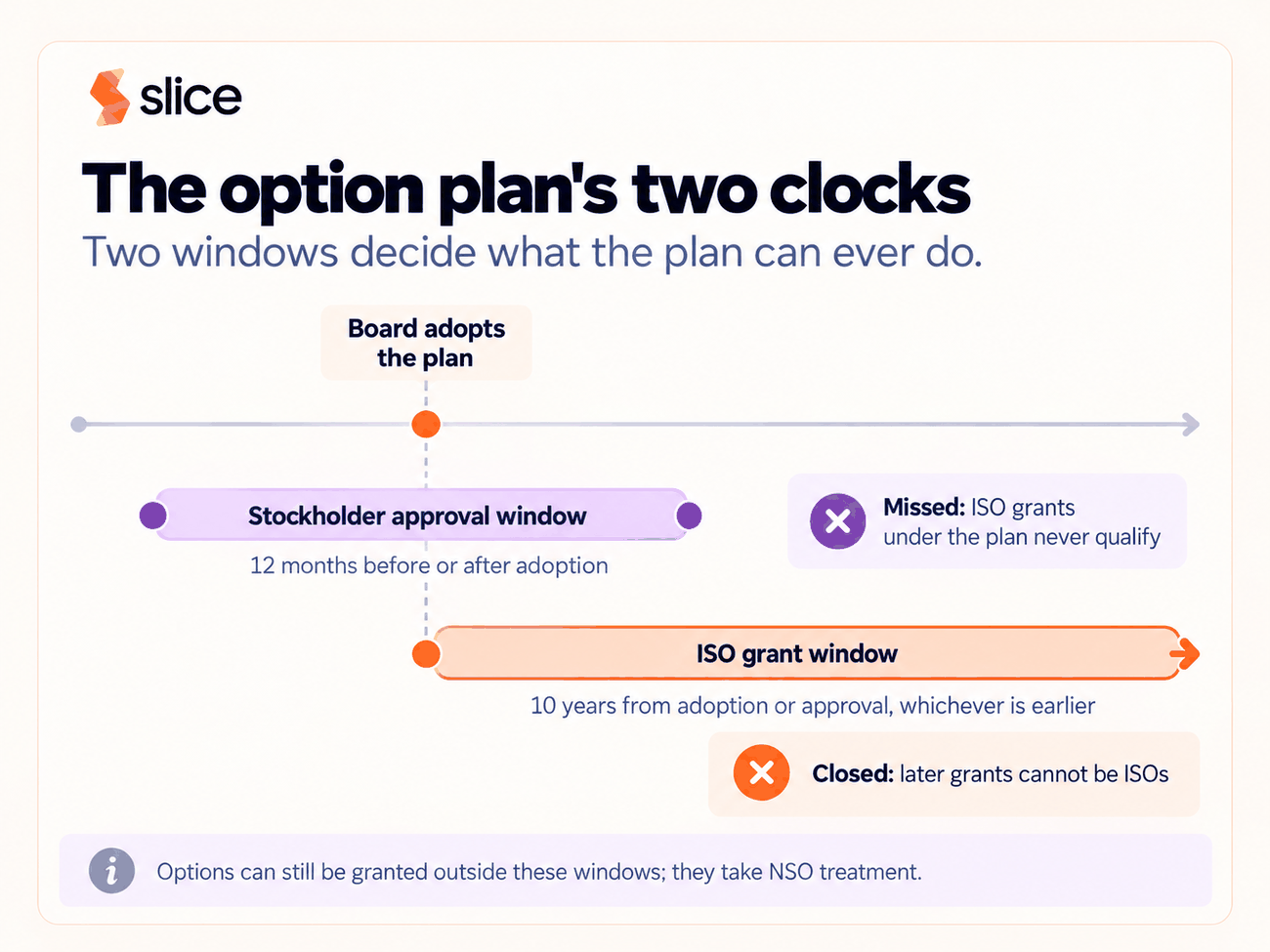
Warning: the stockholder-approval window does not reopen. Approval must land within 12 months before or after the board adopts the plan. A plan that misses the window cannot qualify ISOs, and grants already made as ISOs under it never qualified. The fix is prospective, not retroactive.
Both windows on one timeline, from the day the board adopts:
Adopting an employee stock option plan: approvals, pool, 409A
- The board adopts the plan and reserves the pool.
- Stockholders approve it, inside the 12-month window.
- The grant-date fair market value is established by a reasonable method before the first grants; a qualifying independent appraisal gives a presumption of reasonableness for up to 12 months.
- Grants begin, each documented in a board approval or a validly delegated one.
Practice note. From our experience, every grant approval should record a description of the valuation being relied on and a statement that nothing material has changed since it. The board's continued reliance on a valuation is itself a determination, and writing it down each time helps keep the file defensible later.
The rules that attach to every option plan
409A pricing. Every grant's strike rests on a grant-date fair market value established by a reasonable method. A qualifying independent appraisal carries a presumption of reasonableness that generally cannot be relied on after 12 months or once material new information affects the valuation; a financing, a tender or an acquisition is judged on whether it materially affects value, not treated as an automatic reset.
A plan is only as defensible as the valuation behind its most recent grant; the mechanics live in how stock options are taxed (coming soon).
The $100K ISO limit. The cap applies cumulatively, at grant, in grant order, across plans of the employer and its parent and subsidiaries. Grant-date fair market value of ISOs first exercisable in a calendar year above $100,000 is an NSO from day one, whatever the paperwork says.
Rule 701. The federal securities exemption private-company plans rely on caps what can be offered in any 12 months at the greatest of $1 million, 15 percent of the issuer's assets, or 15 percent of the class, with options measured at grant at their exercise-price value.
Crossing $10 million in a 12-month period triggers enhanced disclosure to recipients of Rule 701 securities in that 12-month period, option holders included, delivered a reasonable period before the first relevant exercise or sale. Where crossing the threshold is foreseeable, waiting until exercises begin risks being late, and a missed disclosure can cost the exemption for that 12-month offering, though another exemption may still be available.
Running the plan after adoption
Eligibility runs wider than ISOs: contractors and non-employees can receive NSOs under the same plan, and cross-border grants bring their own layer, covered in granting stock options to foreign employees.
And the 10-year ISO clock runs whether or not anyone watches it. It starts at adoption or approval, whichever came first, and it does not pause for quiet years. A company that wants ISO capability past that date either adopts a new plan or obtains fresh board and stockholder approval of the existing one. Options already granted do not expire because the ISO grant window closed.
Where Slice fits
Slice flags a grant that crosses the $100K ISO limit and displays the ISO/NSO breakdown, with an ISO/NSO Split Grants ($100K Threshold) report, and compliance alerts are triggered automatically from the equity data itself. The same record holds grants across 66+ countries, so US option grants and grants under other countries' rules sit side by side. You enter or approve the facts; nothing files with regulators automatically.
Frequently asked questions
What is an employee stock option plan?
The legal document a private company adopts in order to grant equity awards. It reserves a pool of shares, defines who is eligible, and sets the terms grants inherit; the board adopts it, and stockholders approve it within 12 months where ISO grants are intended. Individual options then get granted under it, each with its own strike, vesting and term.
Is an employee stock option plan the same as an ESOP?
No. An ESOP, an Employee Stock Ownership Plan, is a retirement-style structure in which a trust holds company stock for employees, under its own body of law. An employee stock option plan grants options and other awards directly to service providers. The initials overlap; the instruments do not.
Does a stock option plan need stockholder approval?
Yes, for ISO qualification: stockholders must approve the plan within 12 months before or after board adoption. A plan without that approval can still grant options, but they take NSO treatment, covered in how stock options are taxed (coming soon).
How long can a company grant ISOs under a plan?
10 years, measured from the plan's adoption or its stockholder approval, whichever came first. After that window closes, further ISO grants need either a new plan or fresh board and stockholder approval of the existing plan. Options already granted are not affected.
What must the plan document specify for ISOs?
Two things, at minimum, in the document itself:
- The aggregate number of shares that may be issued under the plan.
- The class of employees eligible to receive ISOs.
Plus the approvals around it: board adoption and stockholder approval within the 12-month window. The per-grant conditions sit on top, at grant time, covered in how to grant stock options right (coming soon).

Stop stitching five systems to answer one question.


