

Global Equity Management
Carta Alternatives Review: 6 Platforms Built for What Carta Leaves Unmanaged
Explore six Carta alternatives for finance and legal teams managing equity across countries. This guide explains where Carta's model breaks down, compares each platform's compliance coverage and global reach, and lists what to audit before replacing Carta.


For a US startup with one entity, Carta handles most of the equity work, which is why so many founders start there. Things change with the first hire abroad. Granting an option in a second or third country means the same grant, exercise, or termination can be taxed and treated differently depending on where that employee lives.
Most growth-stage teams patch the gap with spreadsheets and outside counsel. It works for a while. Then a mistake turns up during an audit or in due diligence for the next round, when fixing it is slow and costly.
We compared six Carta alternatives on three things: compliance coverage, global reach, and price. The TL;DR table gives the short version. After that, skip to the reviews that fit how your equity program is set up.
What Carta Does Well, and Where Its Model Breaks Down
Carta is the benchmark every tool here gets compared to, so it's worth being clear about what it does well. The trouble starts when grants, employees, and entities sit in more than one country.
Carta's Strengths for US-Based Cap Table and Fund Administration
Carta is the default for many US venture-backed startups. For a US C-corp, the core jobs are covered: cap table, 409A valuations, and ASC 718 expensing. Its investor network is a big part of why so many venture-backed startups default to it.
What Happens When Your Team Is Spread Across Multiple Countries
Every country has its own answer to three questions: when equity gets taxed, who withholds, and what has to be filed. Revolut is a recent example. According to a December 2025 Financial Times report, the company told some former UK staff that their CSOP exercise window had been extended from 60 days to 10 years, then said the change was a disqualifying event. Gains that those employees expected to be taxed at 24% capital gains rates were suddenly exposed to income tax and National Insurance of up to 47%. Read the full case here.
Why Finance and Legal Teams Look for Carta Alternatives
Teams usually start looking after something specific happens: they open in a new country, set up a new entity, or discover a relocation nobody tracked. The same five gaps come up again and again.
- No Built-In Compliance Engine Across International Jurisdictions: Before the board approves a grant in France or Israel, someone needs to check it against local plan rules. A cap table has no way of doing that check, so it falls to a person.
- Tax Events Handled Manually or Outsourced to External Counsel: Any of the four events (grant, vest, exercise, sale) can create a tax obligation, and the country can differ each time. Counsel ends up reviewing them one at a time, often after the fact.
- Single-Entity Architecture That Doesn't Scale Across Subsidiaries: A typical setup has the parent company issuing grants to people employed by local subsidiaries or an EOR. Each of those employers carries its own withholding and reporting duties.
- Mobility and Cross-Border Tax Tracking Left to Spreadsheets: Equity income may be allocated between countries using actual workdays during the relevant vesting period, but two years in the US and two in Germany do not automatically split payroll withholding 50/50; each country’s withholding rules must be assessed separately.
- Reporting Requirements That Differ by Country Require Manual Workarounds: The US has Form 3921, the UK has the ERS annual return, and Israel has Section 102 reporting. Each one comes with its own format and its own deadline.
Carta Alternatives: TL;DR
Granting equity in three or more countries? Start with Slice. Ledgy focuses on UK and European share plans, and Qapita on India and Southeast Asia. The other three work best for smaller teams that want a published price.
Published prices as of November 2026.
6 Best Carta Alternatives in 2026
The first three (Slice, Ledgy, and Qapita) are built for companies with employees spread across several countries. Cake Equity, EquityList, and Capboard are aimed at earlier-stage teams with simpler structures. All details come from each vendor's site as of November 2026.
1. Slice Global
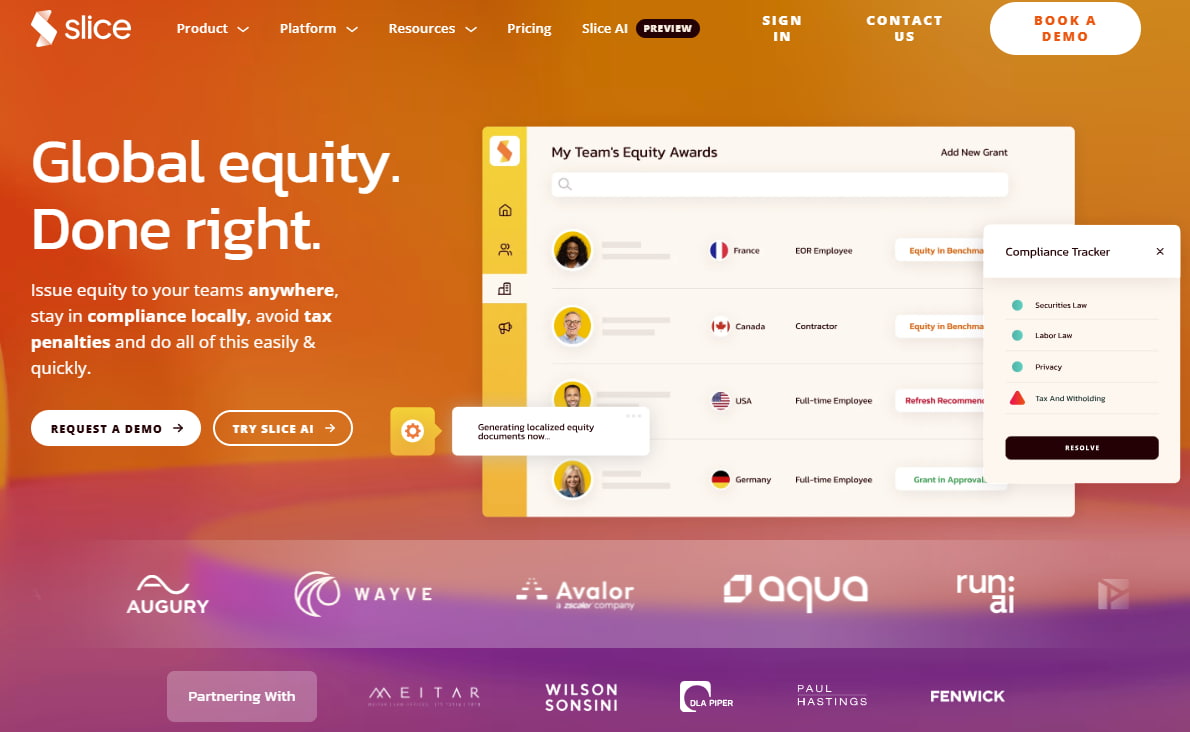
Slice Global is an AI-native equity management platform that checks every grant, exercise, and hire against local rules in 67+ countries, with finance, HR, and legal working from one record. Customers include Wiz, Wayve, and VAST Data, and HiBob named Slice its preferred equity management partner in July 2026.
Best for: Venture-backed companies with 100 to 5,000 employees managing equity in three or more countries.
Strengths:
- Global compliance is built into every workflow, and Slice helps reduce reliance on outside local counsel for equity compliance.
- SliceAI, the built-in agent, handles planning, reporting, and equity questions, while agentic workflows connect HR, legal, and finance through HRIS integrations including HiBob, Workday, BambooHR, Rippling, Deel, and ADP.
- Most companies go live in under two weeks, with free specialist-led onboarding and migration from Carta, Pulley, or Shareworks.
Limitations:
- Pricing is available on request across all plans, so teams will need a demo conversation before comparing costs directly.
- Country coverage scales with the plan, up to unlimited countries on the top tier, so teams pay for the footprint they actually have.
- Implementation is specialist-led, which suits most teams but means the timeline depends on scheduling onboarding with the Slice team.
Customer review:
- "The platform is intuitive, user-friendly, and provides a centralized, transparent view of all equity data." (A.H., VP Finance, mid-market company, G2, April 2026)
2. Ledgy
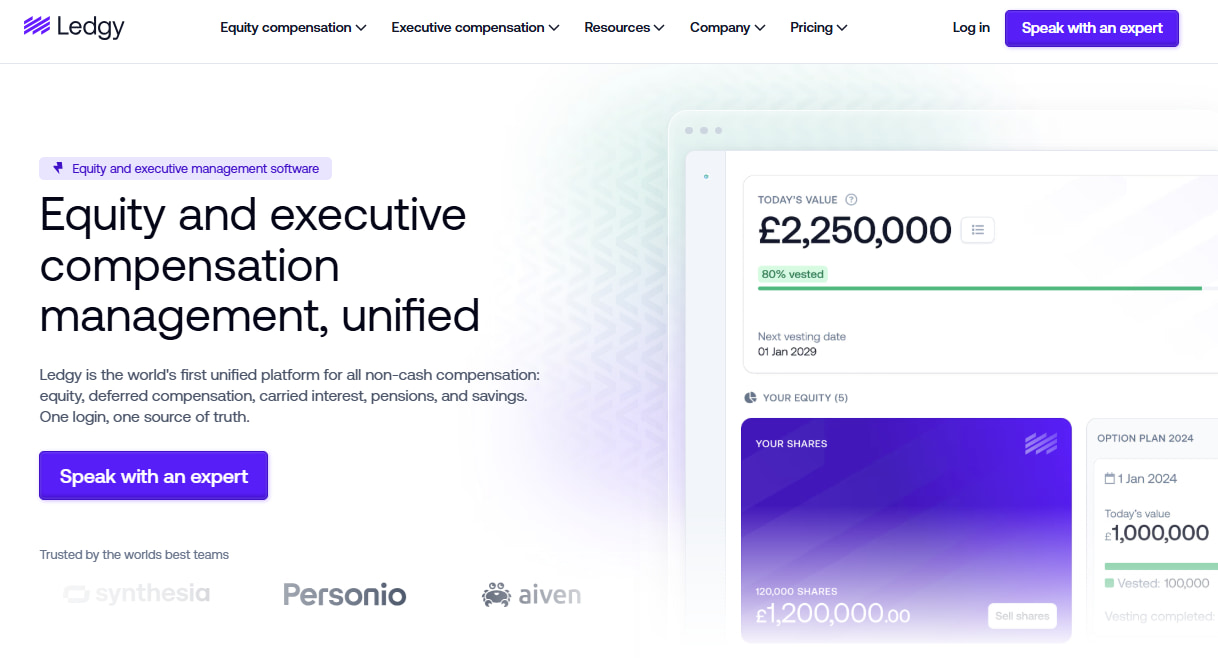
Ledgy is a Zurich-based platform, founded in 2017, for equity, share plans, and executive compensation at private and listed companies. It lists 820+ customers, including Personio, Synthesia, and DeepL.
Best for: European scale-ups and listed companies running UK, US, and German plans side by side.
Strengths:
- Automates UK ERS annual returns and SAYE administration, plus S431 elections and IFRS 2 expensing.
- Runs several plan types in one account, with 70+ HRIS and payroll integrations.
- Covers listed-company needs, including trading, settlement, and payouts in 170+ countries.
Limitations:
- Published compliance depth centers on UK and European companies, with reviewers noting more limited support outside those markets.
- Paid plans are quote-based, and only the Launch plan is free.
- Capterra reviewers cite limited custom reporting and no phone support.
Customer review:
- "Wish I'd moved to Ledgy sooner!" (Head of Legal, Capterra, July 2023)
3. Qapita
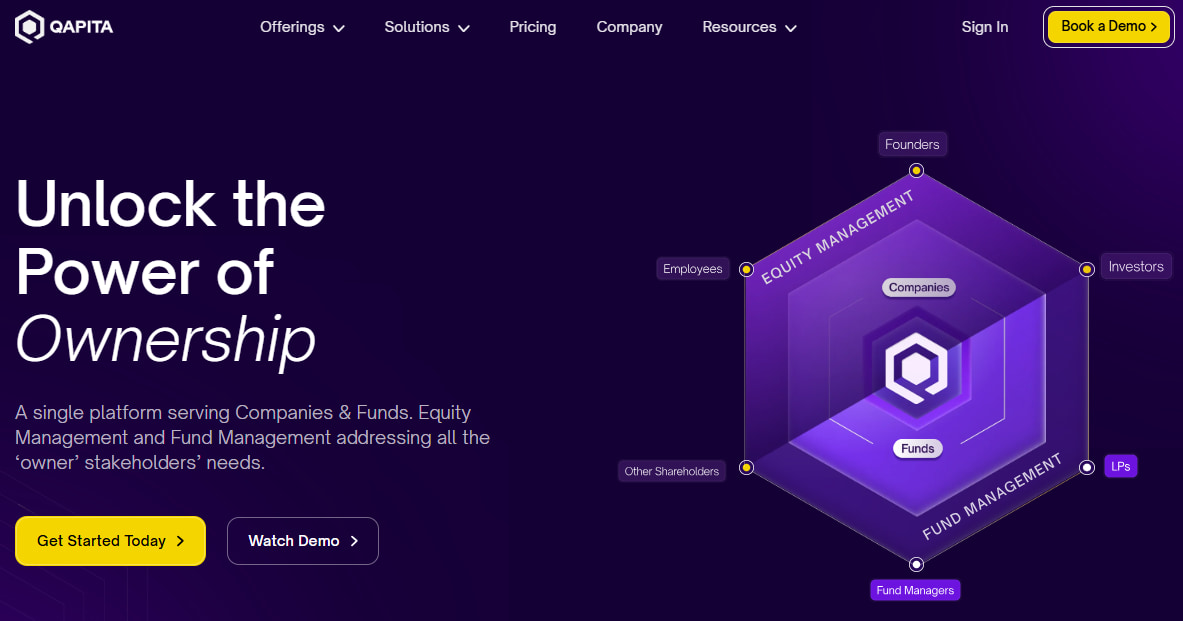
Qapita is a Singapore-based equity management platform with offices in India, Indonesia, and the US. It says that 2,700+ private companies and 180+ listed companies use it, and Charles Schwab led its $26.5 million Series B in October 2025.
Best for: Companies headquartered in India or Southeast Asia that are adding US employees or a US entity.
Strengths:
- Combines cap table, ESOP advisory, tender offers, 409A valuations, and fund administration.
- Strong in India and Singapore, including ESOP SPV setup for Singapore entities.
- Each account gets a dedicated specialist.
Limitations:
- It publishes no country list for its automated tax calculations.
- Its US business is newer, and US expansion was a stated use of the 2025 Series B.
- A G2 reviewer noted the absence of a dedicated mobile app.
Customer review:
- "The platform itself is extremely intuitive, clean, and easy to navigate even for someone without an equity background." (HR/Ops Manager, mid-market company, G2, June 2025)
4. Cake Equity
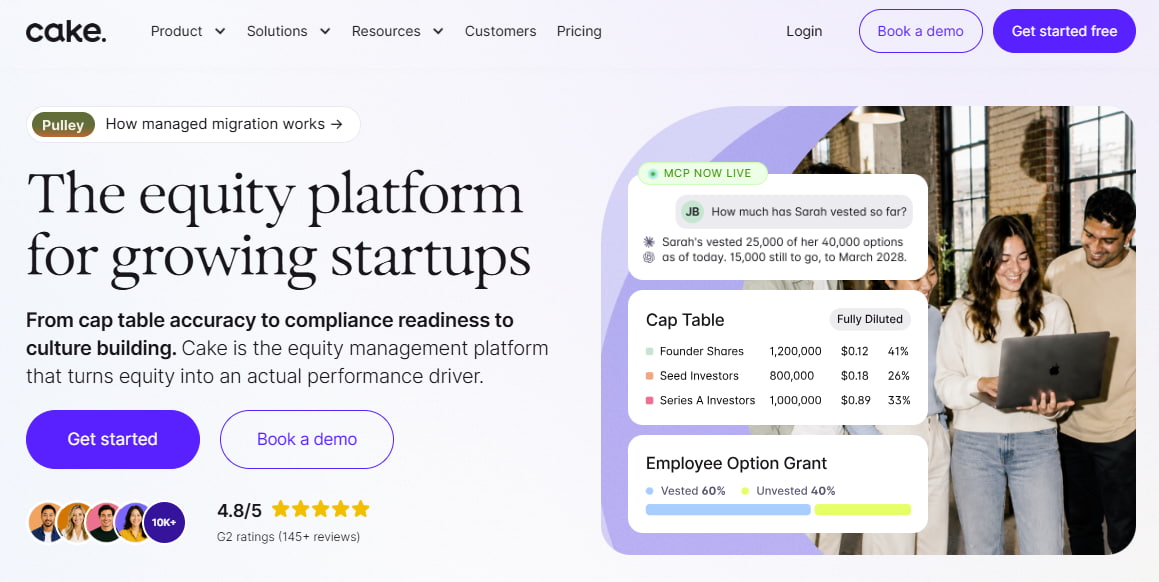
Cake Equity started in Australia and now positions itself as a US equity platform with a Los Angeles team. It covers ISOs, NSOs, RSUs, SAFEs, and warrants, and says 10,000+ companies use it.
Best for: Early-stage US startups that want a self-serve cap table and option plan.
Strengths:
- Migration from another platform takes 3 to 5 days, according to Cake.
- Covers US basics such as 409A valuations, ASC 718 reporting, Rule 701, and 83(b) reminders.
- Templates and guided onboarding help first-time founders set up an option plan.
Limitations:
- Its compliance features target US rules only.
- Form 3921 reporting sits on the quote-based Pro plan.
- Capterra reviewers mention confusing template navigation and slow recalculation.
Customer review:
- Cake holds 4.8/5 from 145+ G2 reviews, and a Capterra reviewer (CEO, IT services company) wrote: "I love how easy to use Cake is."
5. EquityList
EquityList serves companies in India, Singapore, and the US, with a focus on dual-entity and cross-border structures. It covers cap tables, ESOPs, valuations, and secretarial compliance.
Best for: India-US or India-Singapore startups that want equity records and valuations in one place.
Strengths:
- Valuation reports for India, Singapore, and the US (409A) sit next to the cap table.
- Tracks statutory deadlines, with secretarial compliance available as an add-on.
- AI is included on every plan, from Ask EquityList AI to multi-step agent workflows on Enterprise.
Limitations:
- Available only to companies in India, Singapore, and the US.
- Multi-entity support starts on the $3,500-a-year Growth plan.
- G2 reviewers mention occasional bugs and confusing navigation.
Customer review:
- "The tool solves what we were looking for - ESOP pool management with transparency." (Founder, small business, G2, January 2024)
6. Capboard
Capboard is a Spanish equity management platform, founded in 2022, with the US, Canada, and Spain as its primary markets. It covers cap tables, ESOPs, phantom shares, fundraising simulations, a data room, and e-signature.
Best for: Early-stage startups that want a low per-stakeholder price.
Strengths:
- Every feature comes in a single per-stakeholder plan.
- Dilution simulations and investor updates sit next to the cap table.
- Contract generation and e-signing are automated for grants and investor documents.
Limitations:
- It names no jurisdictions or tax filings that it automates.
- Capterra reviewers have asked for automated HMRC and SEIS filings.
- Pricing is per stakeholder, so costs rise as the cap table grows.
Customer review:
- "The support team were friendly and supportive" (Sunil J., CEO and Cofounder, Capterra, November 2026)
Carta Alternatives Side by Side: Comparison Overview
The biggest gap between these platforms is compliance coverage. At one end, Slice has built-in tax logic for 67+ countries. At the other, Cake Equity covers US rules alone. Check each vendor's list against the countries where you grant today.
Vendor-stated coverage, November 2026.
What CFOs and Finance Teams Should Expect From a Carta Alternative
Bring these six capabilities into vendor demos and score each one. Every item on the list is work that currently sits with outside counsel or in a spreadsheet.
- Built-In Compliance Checks Across Countries Without Outside Counsel: The platform should test every grant against local plan rules before it goes for approval and explain any problem in plain language.
- Automated Flagging of Tax Events at Grant, Vest, Exercise, and Sale: For every event, you should be able to see which country taxes it, who withholds, and when the payment is due.
- Cross-Team Workflows That Connect HR, Legal, and Finance on One Platform: When someone is hired, terminated, or relocated in the HRIS, the matching equity workflow should kick off automatically.
- Real-Time Mobility Tracking Across Relocating Employees: If an employee moves mid-vest, the platform should track workdays and support income allocation under the applicable sourcing rules, while withholding must be assessed separately under each country’s requirements.
- Country-Specific Reporting Without Manual Adaptation: Form 3921, UK ERS returns, and Israeli Section 102 reports should all be generated from the same dataset, each in the format the local authority expects.
- AI That Surfaces Exposure Risks Proactively: Look for AI that reviews past grants for risk you already carry and answers equity questions using live data in the platform.
Before You Switch: What to Audit Before Replacing Carta
Switching platforms will surface every gap in your current records. Better to find them yourself before you sign.
- Mapping Your Current Equity Program Across Countries and Entities: Write down every issuing entity, local employer, EOR, and plan or sub-plan, along with the countries each one covers.
- Whether Your Primary Gap Is Cap Table Records or Compliance Coverage: Most tools on this list can clean up ownership records. Tax and local filings need built-in compliance, and fewer vendors offer that.
- How Many Countries Your Team Is Managing Equity in Today: Count the countries you grant in now and the ones planned for the next 18 months. Then check how many countries each vendor's plans allow.
- Data Migration, Historical Grants, and Continuity During the Transition: Ask who checks historical grants during migration, how long the cutover takes, and whether you can run both systems side by side for one cycle.
Conclusion
Which Carta alternative makes sense comes down mostly to how many countries your equity program covers. Ledgy is built around UK share schemes and listed-company plans. Qapita is a good match for teams headquartered in India or Southeast Asia, and EquityList handles India, Singapore, and US structures at a published price. For early-stage teams watching costs, Cake Equity and Capboard are the cheaper options.
If you grant equity in several countries, our pick is Slice. Compliance for 67+ countries is built into every grant, exercise, and hire. Finance, HR, and legal work from the same record, and most teams are live in under two weeks.
Yalli Canaani is an accomplished marketing leader with more than 15 years of experience across B2B and B2C businesses, specializing in go-to-market strategy, brand building, growth, and consumer marketing. As Head of Marketing at Slice Global Equity, Yalli leads the company’s marketing strategy, brand development, and growth initiatives. Previously, she was VP of Marketing at Waltz, a FinTech company, where she built the marketing function from the ground up and helped scale the company from stealth to launch and international expansion across the US, LATAM, and Canada.


Global Equity Tax
How Stock Options Are Taxed for International Employees: A Compliance Guide
Depending on where its holder worked and which sub-plan existed, one option grant can be taxed as salary in France at exercise, partly in the UK for the years spent in London, or only at sale, and the US plan document decides none of that on its own. Many of the conditions behind each outcome are set at grant, and few can be repaired once the option has been exercised.

News
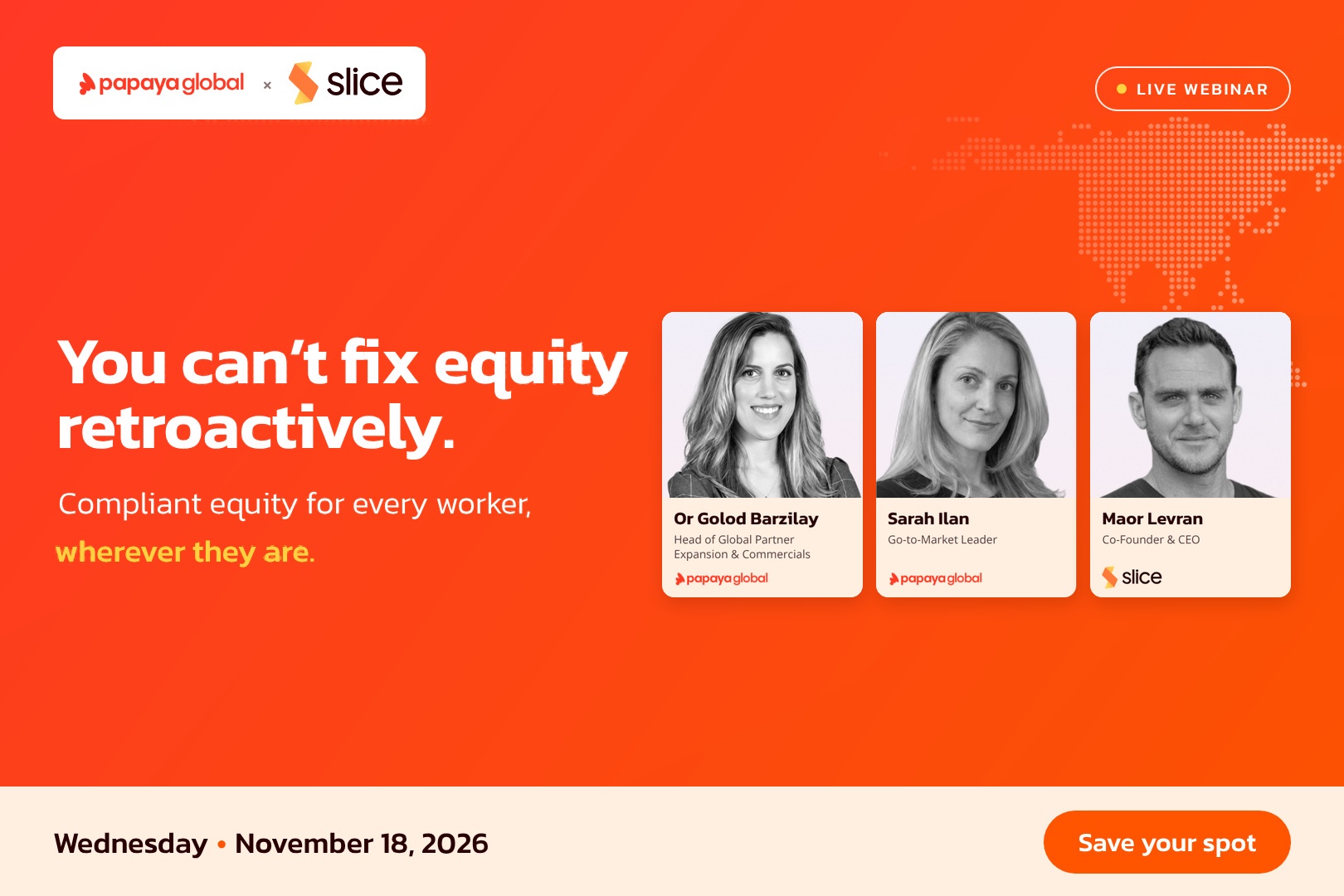
Webinar: You Can't Fix Equity Retroactively
Granting equity to EOR and payroll workers isn't standard HR paperwork. Join Slice and Papaya Global on Nov 18 to learn why handling and filings must happen at grant.

Global Equity Management
Best Global Equity Management Software for Multi-Country Companies Reviewed in 2026
Recording a grant for a London or Berlin hire takes one screen. Knowing whether it can be made on those terms, and what it triggers later, is where global equity platforms split, and five of them are reviewed here on how much of that legal and tax work they carry.

Manage your equity worldwide
Book a Discovery Call

