Product
Revolut’s Options CSOP Mishap & Impact on Employees
Discover how Revolut's equity compliance error turned tax-advantaged CSOP options into costly liabilities. Learn about post-termination exercise periods (PTEP), disqualifying events, and how automated compliance can prevent unexpected tax bills for employees
.jpg)
TL;DR
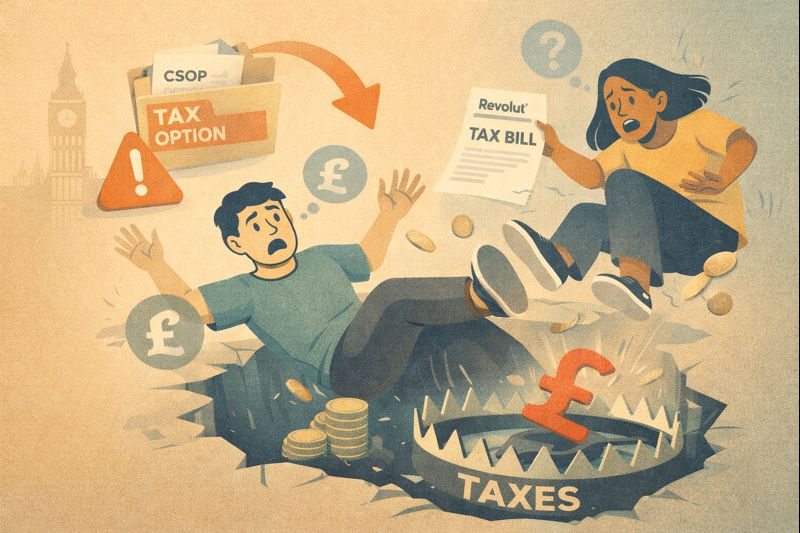
- The Incident: Revolut employees faced unexpected tax bills after exercising options in circumstances that were later treated as non-qualifying for CSOP tax purposes, following changes or clarifications around post-employment exercise.
- The Rule: CSOP tax treatment depends on statutory qualifying conditions, including timing relative to grant and the circumstances in which an option is exercised. Contractual post-termination exercise windows only preserve CSOP tax treatment if they align with what HMRC recognises as statutory exceptions.
- The Impact: Gains are taxed as Employment Income (combined top rates reaching 47%) instead of Capital Gains (24%), a massive financial difference.
Recent reporting around Revolut has put a spotlight on an uncomfortable truth in equity management: even widely used, well-intentioned share option schemes can fall apart when critical details are not made explicit at the moment they matter most in employee equity programs.
The issue is not that equity is misunderstood in theory. It is that in practice, people make decisions based on timelines and assumptions that feel reasonable, but do not always hold up once tax rules apply.
What Actually Went Wrong with CSOP Share Options
At the centre of the situation were Company Share Option Plans (CSOPs), a UK tax-advantaged share option scheme. CSOPs are commonly used by companies managing equity at scale because they allow employees to pay capital gains tax on profits rather than income tax, provided strict statutory conditions are met.
According to reporting by the Financial Times, some former employees believed they were exercising options in a way that preserved those tax benefits. They were later informed that changes to how and when their options could be exercised, particularly after leaving the company, meant the exercise was treated as a disqualifying event.
As a result, gains were taxed as employment income plus National Insurance contributions, rather than capital gains tax.
The Tax Impact: A Significant and Unexpected Difference
The difference in tax treatment is significant:
- Capital Gains Tax: 24%
- Income Tax + National Insurance Contributions: 47%
The same equity event can therefore lead to dramatically different outcomes depending on how it is treated.
What Employees Thought They Were Doing
Employees did not believe they were bending the rules. Based on earlier communication, some believed they had up to ten years to exercise their options and remain within CSOP-qualifying conditions. When a buyback opportunity appeared, they acted on that understanding.
What they did not fully appreciate - and what was not consistently clear - was that more than one clock was running, and that an option’s exercise window and its overall lifespan are entirely different timelines.
Two Equity Timelines With Very Different Implications
Understanding the difference between these two timelines is critical:
1. How Long an Option Exists (Option Lifespan)
- Most share options are valid for a fixed period from the date they are granted.
- Often up to 10 years.
- Defines how long the option remains legally exercisable under the plan.
2. The Post-Termination Exercise Period (PTEP)
- The much shorter window after someone leaves a company.
- Often 30 to 90 days after departure.
- During this period, a former employee is allowed to exercise their options.
Why This Distinction Matters
These timelines serve very different purposes, but they are frequently conflated. In this case, some employees appear to have assumed that exercising within the overall option lifespan meant they were still operating within CSOP rules.
In reality, exercising options in a way that falls outside the statutory conditions for CSOP qualification - even if permitted under plan terms - can invalidate the tax-advantaged treatment.
This distinction is not intuitive. It is also not something employees can reasonably infer without it being clearly surfaced, explained, extended and reinforced.
Why This Triggered a Disqualifying Event
CSOPs are governed by statute. Tax treatment depends on how an option is exercised, not on internal policy decisions, intent, or labels like "good leaver."
What Happened in the Revolut Case
- The company extended the post-employment exercise window.
- This meant the options no longer met the conditions required for CSOP tax treatment.
- For CSOP purposes, the exercise is treated as non-qualifying.
- Any gains are taxed as employment income instead of capital gains.
Why Changes After Grant Are Risky
Once a statutory condition is breached, the tax outcome changes automatically. There is no clean way to reverse it later.
Why This Is a Problem for Both Sides
For Employees
The impact is obvious: a financial decision made in good faith can lead to a far worse outcome than expected, often discovered only after the fact.
For Companies
The damage runs deeper:
- Trust erodes quickly, even if corrections are made.
- Legal and tax exposure increases.
- Future equity grants become harder to explain and harder to defend.
None of this requires bad intent. It only requires ambiguity to persist for too long.
Where Equity Management Breaks at Scale
As companies grow, equity becomes more complex by default:
- Employees join, leave, and relocate.
- Buybacks and secondary liquidity become more common.
- Tax rules vary by scheme, jurisdiction, and timing.
- Decisions made years earlier suddenly carry real financial consequences.
This is the point where manual processes fail - not because teams are careless, but because equity systems were never designed to surface consequences, only permissions.
Why Slice Global Was Built This Way
This is exactly why Slice Global was built the way it is, with compliance at the centre of everything.
The Problem Slice Global Solves
Equity issues rarely surface at grant time. They surface years later:
- When someone leaves.
- When a buyback appears.
- When an employee is asked to make a decision that cannot be undone.
Admin teams are expected to manage that complexity across multiple jurisdictions, different equity schemes, varying tax rules, and historical grants - often with incomplete context and fragmented tools.
Employees, meanwhile, are left trying to understand which rules apply to them personally, right now, not in theory.
How Slice Global Closes the Gap
Slice closes that gap by tying equity data, employment status, jurisdiction, and tax context into a single system. Admins get compliance that holds up under scrutiny. Employees get clarity before they act. That is how equity remains a trust-building tool instead of becoming a dispute years later
Why This Matters Now
Buybacks and secondary liquidity are no longer edge cases for private companies. They are becoming part of normal equity lifecycles.
That raises the bar. Equity transparency is not important because regulators demand it. It matters because the cost of getting it wrong often appears years later, when trust is hardest to repair.
A Simple Question for Your Organization
If this situation feels uncomfortably familiar, it is worth asking a simple question:
Would your employees see this risk before they exercise, or only after?
Frequently Asked Questions (FAQ)
Q: What is a CSOP and why do companies use it?
CSOPs (Company Share Option Plans) are UK tax-advantaged share option schemes that allow employees to pay capital gains tax on profits instead of income tax, provided specific statutory conditions are met. They are commonly used by scaling companies because they offer a balance between employee incentives and predictable tax treatment.
Q: What is a post-termination exercise period (PTEP)?
A post-termination exercise period (PTEP) is the limited window after an employee leaves a company during which they are allowed to exercise their share options. This period is usually much shorter than the overall lifespan of the option and can have significant tax implications if misunderstood or extended.
Q: Can extending an exercise window change the tax treatment of options?
Yes. Allowing exercises outside CSOP statutory conditions can trigger disqualifying tax treatment, even if permitted under the plan. When this happens, gains may be taxed as employment income rather than capital gains.
Q: Why do equity disputes often surface years after options are granted?
Equity issues tend to emerge during inflection points such as employee departures, buybacks, or liquidity events. By the time these moments occur, decisions made years earlier suddenly become financially relevant, and gaps in documentation, communication, or system design are exposed.
Q: Why is equity taxed differently at different stages?
Equity is taxed based on what has actually happened economically:
- At grant: Usually no tax because no value has changed hands.
- When options are exercised: Tax depends on the type of plan and whether its conditions are met.
- When shares are sold: Tax is applied to any gain in value.
Each stage reflects a different transfer of value, which is why tax rules change over time.
Daniel Penso is a Product Manager at Slice, where he works at the intersection of engineering and customers to build, plan, and implement products that are shaping Slice into the leading AI-driven global equity management platform for companies worldwide. He focuses on translating complex requirements into intuitive product experiences while strengthening the processes and operations that power Slice behind the scenes.


Product
What Happens to Equity When Employees Move Countries
When an employee moves countries while holding unvested equity, the taxable income generally gets split between both countries based on where they actually worked during the vesting period


.png)
.svg)