

Global Equity Management
Best Cap Table Software for 2026: Top 6 Picks for Finance, Legal & HR Teams
A practitioner review of six cap table platforms for companies granting equity in more than one country, with comparison tables, three pros and cons per tool, and an honest look at the work that stays outside the software, whichever vendor you pick.


Key Takeaways
- A cap table records ownership; it does not administer the law. Every platform here tracks shares and vesting accurately, and none files a return where the employee sits.
- The compliance surface is wider than tax. Baker McKenzie's global equity reference spans tax, securities, exchange control, labor law, and data privacy across 50 countries.
- Fit is decided by footprint, not feature count. A US-only startup and a company in five countries are shopping for different products.
- Slice is built for the multi-country case. The AI-native global equity management and compliance platform checks every grant, exercise, and hire against local law across 60+ countries.
A US company closes its Series B, hires four engineers in London, two in Berlin, and three in Toronto, and extends the existing option plan to all nine. The cap table records every grant correctly. 11 months later, three problems surface. The UK grants could have been written as Enterprise Management Incentives, which carry no income tax at exercise when the option was granted at market value, and nobody structured them that way. The Berlin hires owe German income tax at exercise even if they sell nothing, because Germany taxes the spread on exercise. And in Canada, the employer had to tell the employee and the Canada Revenue Agency within 30 days of the agreement whether the options qualified for the stock option deduction, and no one did.
None of that is a cap table failure, because the records were accurate throughout. The better question is not which platform stores ownership data best - since most do it well - but which one fits the work around the cap table in your footprint. This article reviews six platforms and the criteria that separate a system of record from one that handles the law.
The Five-Tool Patchwork That Passes for Equity Management at Most Global Companies
Companies granting equity in more than one country rarely run it on one system. They run it on five, because no single tool covers finance, legal, and HR at once.
- A Cap Table Tool That Tracks Ownership and Stops There. The platform holds the share register, the pool, vesting schedules, and scenario models, but not the tax and filing rulebook for the country each employee lives in.
- HRIS Platforms That Hold Employee Data but Cannot Talk to the Equity System. Every equity obligation starts as an HR event, and when the two systems are not synchronized, equity data runs weeks behind the truth.
- Spreadsheets Bridging Every Gap the Above Tools Leave Open. One workbook tracks which grants sit in which country and which filings are due, maintained by people whose memory is the real control.
- Outside Lawyers Hired Country by Country Wherever Equity Has Been Granted. The advice is usually good, but it arrives per question, on a delay, and never lands back in the system of record.
- Local Accountants Handling Tax Obligations No Platform Was Built to Track. Withholding and annual returns sit with accountants who see the transaction afterward, once the decisions that mattered can no longer be reversed.
Best Cap Table Software in 2026: TL;DR
The table below places each platform by what it is built to do and the type of companies it serves best.
6 Best Cap Table Software Platforms in 2026
Each review covers what the platform is built to do, followed by pros and cons, based on each vendor's own public product information.
1. Slice Global
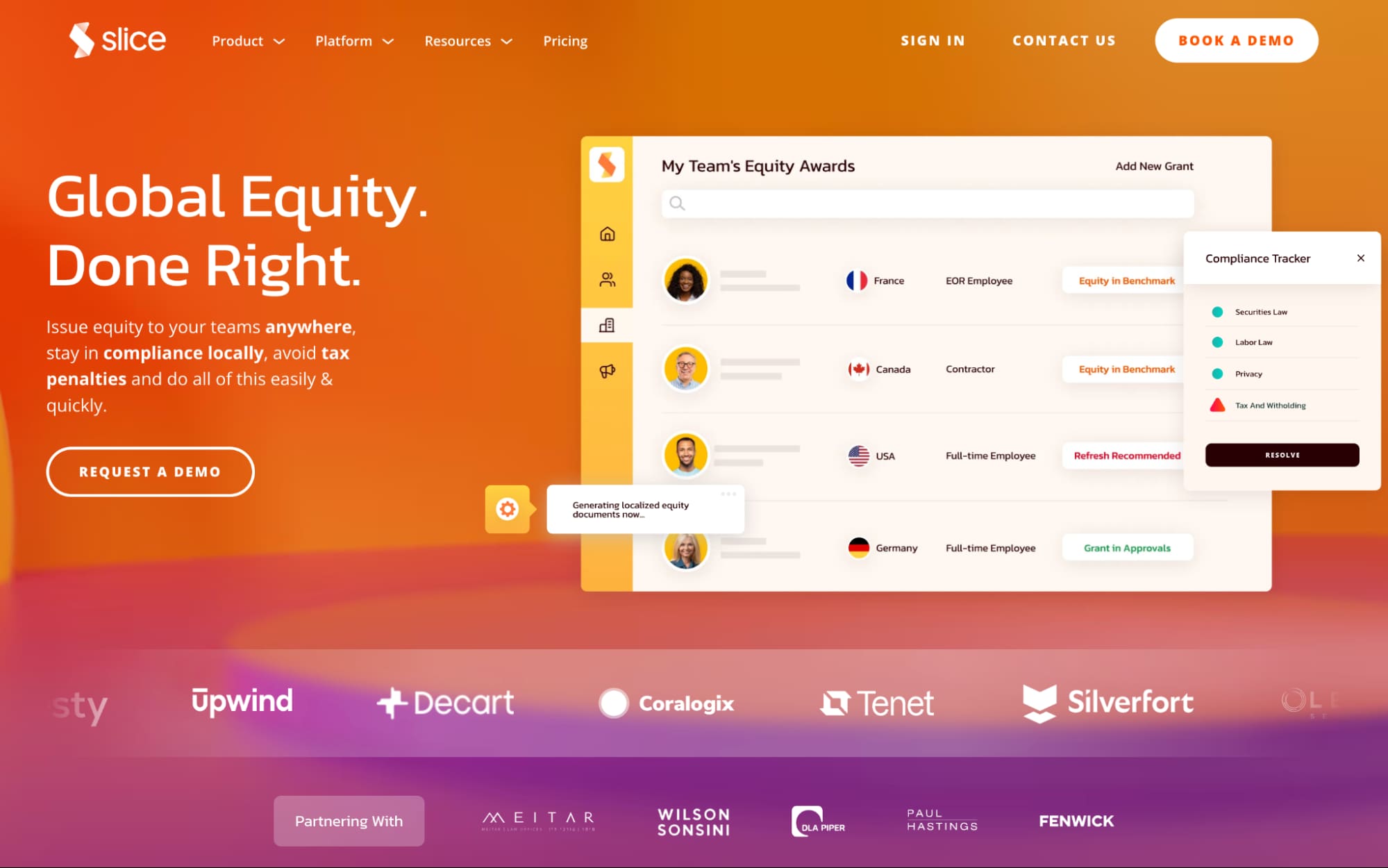
Slice is the AI-native global equity management and compliance platform, covering cap table, equity grants, exercises, approvals, country-specific reports, and compliance in one system. It is the only platform here where AI and compliance are built into the workflow itself rather than bolted on afterward, so every grant, exercise, and hire is checked against local law in real time, and exposure is prevented rather than discovered.
Pros:
- Built-in compliance for companies granting equity across two or more countries, reducing reliance on outside counsel.
- Finance, Legal, and HR can work from a single source of truth through agentic workflows synced with the HRIS.
- Stock-based compensation and tax reporting can be generated from the same record that tracks every grant and exercise, rather than rebuilt manually each quarter.
- Makes it easy to facilitate tender offers and secondary transactions.
Cons:
- A single-country team that intends to stay that way will not use most of it.
- It is not investor-side tooling, so funds needing fund administration should look elsewhere.
- Teams wanting a plain share register will find the compliance layer heavier than they need.
2. Carta
Carta is an equity management platform with a focus on the US market, covering cap table management, 409A valuations, employee equity plans, fund administration, and liquidity events. US investors, auditors, and law firms treat Carta records as the standard format, while the legal and tax treatment of international grants is largely left to outside counsel.
Pros:
- The widest US ecosystem, so investors and auditors are already familiar with it.
- Cap table, 409A valuation, and fund administration come from one vendor.
- Liquidity events, including tender offers, are handled in-platform.
Cons:
- International grants are recorded rather than administered, so local filings stay with local advisors.
- Pricing and ecosystem scale are heavy for a team that needs only a share register.
- Coordination across finance, HR, and legal stays manual around the system of record.
3. Qapita
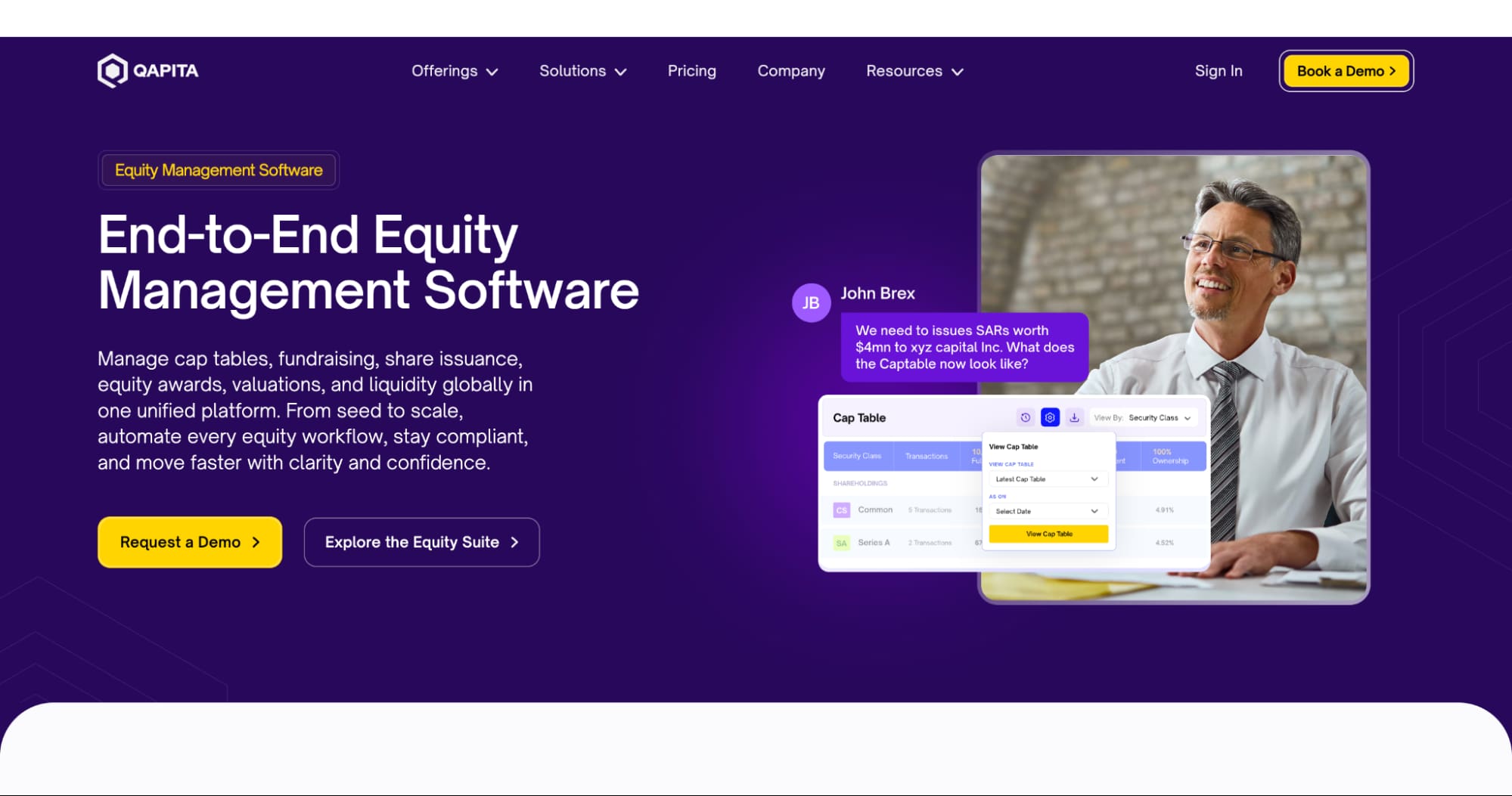
Qapita is a Singapore-headquartered equity and ESOP management platform built primarily for India and Southeast Asia, covering cap tables, plan design and issuance, valuations, and regional compliance. Its strength is depth in a region most US-built platforms treat as an edge case, including the local documentation those markets require.
Pros:
- Real regional depth across India and Southeast Asia, including local ESOP documentation.
- Plan design, cap table, valuations, and the employee experience in one platform.
- A strong fit when the parent entity or most headcount sits in Asia.
Cons:
- Coverage is weighted to Asia, so a US-parented plan granting into Europe gains less.
- US investors and auditors are less likely to already work in the platform.
- Compliance strength is regional rather than uniform across every country a plan touches.
4. Eqvista

Eqvista is a cap table platform whose commercial center of gravity is the 409A valuation, bundled with the cap table for US private companies. Its 409A pricing is published by funding stage, unusual in a market where most vendors quote on request.
Pros:
- Published, stage-based 409A pricing makes budgeting possible before any sales call.
- The cap table is bundled with the valuation rather than billed separately.
- Low cost of entry for a seed company issuing its first grants.
Cons:
- Oriented to US valuation and reporting, not multi-country equity administration.
- Cross-border tax treatment and local filings are outside its scope.
- Companies past the stage where the cap table is the hard part will outgrow it.
5. Shareworks by Morgan Stanley

Shareworks is the equity plan administration platform inside Morgan Stanley at Work, aimed at large private and public companies. It combines plan administration, participant brokerage accounts, and reporting, including a sandbox for modeling and budgeting scenarios before they are committed.
Pros:
- Enterprise-grade administration built for public-company and pre-IPO requirements.
- Participant brokerage and equity administration sit with one institution.
- Modeling tools support finance teams planning dilution and expense in advance.
Cons:
- Scale and cost are aimed at large organizations, not growth-stage companies.
- Implementation is a project measured in months rather than a self-serve setup.
- Local legal and tax compliance stays an advisory relationship, not a product feature.
6. Cake Equity
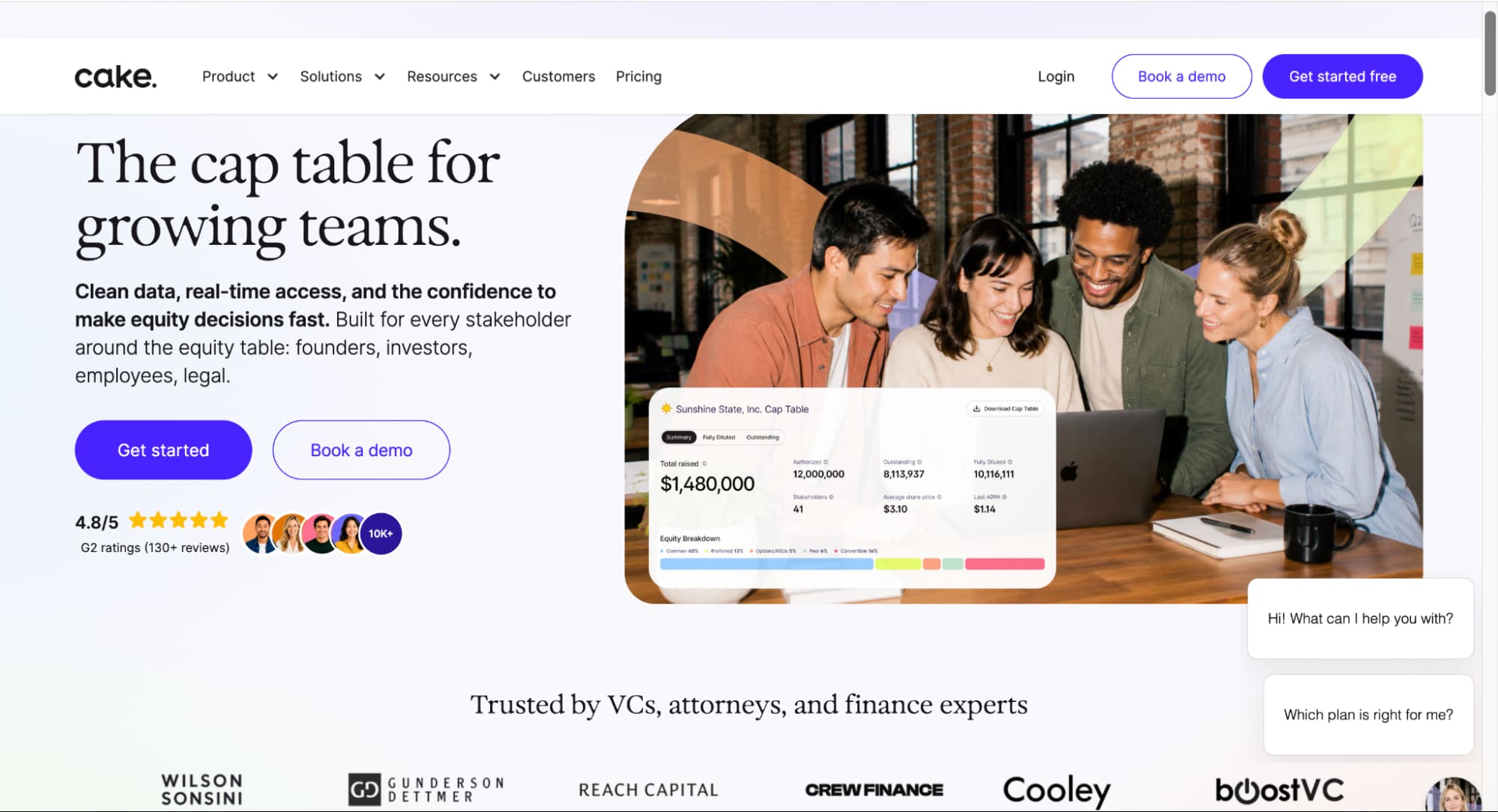
Cake Equity is a cap table and equity platform that began in Australia and now serves the US and UK, covering real-time cap table data, scenario modeling, audit trails, and issuance of options. It also lets distributed companies group option pools by country, which eases administration without changing the underlying legal treatment.
Pros:
- Fast, low-friction setup and issuance, which suits founders leaving spreadsheets.
- Broad instrument coverage across options, RSUs, SAFEs, notes, and warrants.
- Option pools can be grouped by jurisdiction for cleaner administration.
Cons:
- Pool grouping organizes administration without supplying local tax and filing logic.
- Depth in any single jurisdiction is lighter than a specialist regional platform.
- Continuous compliance monitoring across countries is not part of the product.
Cap Table Software Comparison Overview
The table below sets the same six platforms against the three factors that decide the choice for a multi-country team.
What Every Cap Table Tool Covers and Where the Real Work Still Falls on You
These platforms differ less than their marketing suggests at the record-keeping layer and far more at the legal layer. Four capability bands show where the software stops.
- Ownership Records, Vesting Schedules, and Scenario Modeling Most Tools Handle: Every platform here keeps the share register, computes vesting across time-based, cliff, and milestone structures, and models dilution, so a demo that lingers here is showing you the commodity.
- 409A Valuations and Investor Reporting Where Platforms Start to Diverge: Some vendors deliver the valuation, some bundle it, and some pass it to a partner firm, so what matters is refresh speed and how defensible the methodology is under audit.
- Cross-Border Tax Events and Local Filing Obligations Left Entirely to Outside Counsel: Whether Germany taxes at exercise, whether a UK grant qualifies for EMI, and whether a Canadian grant crossed the annual vesting limit all have statutory answers that most platforms record around rather than apply. Relocations compound it, because moving countries mid-vesting splits one award across two tax regimes.
- Finance, HR, and Legal Coordination That No Cap Table Tool Was Designed to Connect: One grant needs finance approval, HR data, and a legal check on the jurisdiction, and since the record holds the outcome and none of the process, coordination across the three is where the time goes.
Why "Finding a Better Cap Table Tool" Is the Wrong Question to Ask
Most evaluations compare cap table platforms feature by feature, which assumes the cap table is the constraint. For a single-country company that holds, and for a company granting in five countries, it does not.
The Real Problem Is Not the Cap Table Tool, It Is Everything Around It
In the scenario opening this article, the cap table was accurate at every step. What failed sat outside it, in the structuring decision in the UK, the timing decision in Germany, and the notification requirement in Canada. A better interface on the cap table changes none of the three, because none are record-keeping problems. They are questions of which law applied and when, and no system in the stack owned the answer.
Why Finance and Legal Teams Assume the Spreadsheets-and-Lawyers Layer Is Unavoidable
The patchwork persists because it looks like the cost of doing business rather than a solvable problem, and because the legal surface behind it is genuinely wide. Baker McKenzie's global equity reference covers tax, securities, exchange control, labor law, and data privacy across 50 countries, which is five legal domains per jurisdiction. Hiring specialists country by country is a reasonable response to that, just no longer the only one.
What Equity Management Actually Requires When Your Team Spans Multiple Countries
A multi-country plan needs the local rulebook applied at the moment of the decision, and HR data flowing in continuously, because relocations and terminations change tax treatment. It needs filings tracked per jurisdiction, including recurring ones such as the UK ERS annual return and Australia's ESS reporting deadlines. And it needs all three functions on one record, because coordination cost grows faster than headcount.
What to Look for in Cap Table Software
If your footprint is already global, the useful evaluation questions are not about the cap table module at all.
- Whether Compliance Is Monitored Continuously or Only Flagged After Something Goes Wrong? A rule library accurate at onboarding decays as statutes change, so ask how you find out a local rule moved and treat a quarterly newsletter as a no.
- How the Platform Handles an Employee Relocating Mid-Vesting? This is the best single test of whether the compliance layer is real, and an answer beginning with "consult your tax advisor" means the product does not do it.
- Whether Outside Counsel Is Still Required for Country-Specific Filings? The gap between generating a country-specific document and reminding you to commission one is most of the annual cost of running a global plan.
- Whether Finance, HR, and Legal Workflows Connect in One System or Require Manual Reconciliation? Ask for a walkthrough of one grant from HR event to legal approval to finance record, because if the demo involves an export and a spreadsheet, that is what you are buying.
- How Quickly Can New Countries Be Added Without a Separate Implementation Project? Ask what happens when your first hire lands somewhere new, and whether that is a configuration change or a fresh project.
How Slice Replaces the Entire Patchwork with One AI-Native Global Equity Platform
Slice Global approaches the problem from the compliance side, built around the move from equity as record-keeping to equity as regulatory infrastructure.
- Cap Table and Equity Records Managed Alongside Compliance, Not Separately From It: The share register, grants, approvals, and exercises sit in the same system as the legal checks governing them, so a grant is validated against the employee's jurisdiction as it is created.
- Continuous Global Compliance Across 60+ Countries Without Hiring Local Counsel: The global compliance engine monitors equity data continuously and raises alerts tied to the specific structure and regulation involved, across 60+ countries.
- Automated Tax Optimization That Captures Local Regimes Before Deadlines Pass: Tax-advantaged treatment applies only when conditions are met on time, so Slice maps each grant to the regime it can qualify for and tracks the attached deadlines.
- Finance, HR, and Legal Workflows Connected in One Agentic System: Integrated agentic workflows carry a grant from the HR event through legal review to the finance record with no export in the middle, and HRIS Sync keeps that data current as people move.
- Country-Specific Grant Letters, Filings, and Reports Generated Automatically: Grant letters, templates, and country-specific reports come out in the form each jurisdiction expects, with Audit Trails tying every document to the approval behind it.
- SliceAI Answers Any Equity Question on Demand Without Sensitive Data Leaving the Platform: SliceAI is a single secured agent inside the platform, running planning, reporting, and legal questions against your own equity data without it leaving the system.
Conclusion
The cap table software market in 2026 is good at what it was built for. Carta, Qapita, Eqvista, Shareworks, and Cake Equity each serve their home segment well, and for a single-country team the choice is a question of stage and budget. What none of them solves is the multi-country case, where the hard part of equity stopped being the register and became the law attached to every grant.
That is the case Slice was built for. The AI-native global equity management and compliance platform checks every grant, exercise, and hire against local law in real time across 60+ countries, generates the filings that follow, and goes live in about two weeks. If your next hires are in countries your current stack has never handled, see how Slice keeps global equity compliant before the first grant goes out.
FAQ
What does cap table software actually manage?
Cap table software is the system of record for who owns what, but global companies also need workflows for the legal, tax, approval, and reporting obligations attached to equity.
- Use the cap table to maintain ownership, grants, equity pools, vesting schedules, and transaction history.
- Separate record accuracy from compliance: a correctly recorded grant can still create missed tax treatment, filings, or employee notifications in another country.
- Before selecting software, map where employees and award holders are located and identify which equity events require country-specific handling.
- For multi-country teams, evaluate the workflow surrounding each grant, not only whether the resulting ownership record is correct.
See how to manage all types of securities and equity grants in one unified cap table.
When should a company move from spreadsheets to cap table software?
A company should move when equity activity becomes difficult to reconcile reliably across grants, approvals, exercises, employee changes, and ownership records.
- Establish one controlled source of truth for the share registry, equity pool, grants, and exercises rather than maintaining parallel spreadsheets.
- Define who can create, approve, and modify equity records so responsibility does not depend on institutional memory.
- For international employees, maintain jurisdiction and employee information alongside the equity data because the same award can have different obligations by country.
- Treat the migration as an operating-process change: document approvals, data ownership, reporting responsibilities, and exception handling.
Learn more about Slice equity plan administration.
What should a global company test before choosing cap table software?
Global companies should test whether the platform can support country-specific obligations, employee mobility, permissions, approvals, reporting, and auditability, not simply maintain an accurate ownership ledger.
- Run a sample grant through several jurisdictions and identify where local legal or tax review enters the process.
- Test a mid-vesting employee relocation, because the employee's changing jurisdiction can affect the treatment and administration of an existing award.
- Trace one transaction from HR data through equity approval, documentation, reporting, and the final cap table record.
- Ask how permissions and audit trails establish who changed or approved critical equity information.
Review what changes when equity holders move countries.
How does Slice connect cap table data with global equity compliance workflows?
Slice brings employee and equity-event data into the equity workflow, evaluates the relevant country-specific compliance considerations, and gives operators a path to act before maintaining the resulting equity record.
- Employee and equity information enters Slice through the relevant equity workflow and supported data synchronization.
- Slice's global compliance capabilities monitor the equity data for relevant country-specific requirements and exposure.
- Finance, legal, HR, or equity operators can then address the identified requirement through the appropriate approval, documentation, reporting, or administration workflow.
- Keeping the compliance workflow alongside the equity record reduces dependence on separate spreadsheets for tracking what must happen around the cap table.
Explore Slice global equity compliance.
Gal Acrich is an accomplished lawyer and accountant specializing in technology and equity management. Holding dual Bachelor’s degrees in Law and Business/Management, Gal currently leads Business Development & Compliance at Slice. This role involves navigating complex international equity regulations and tax codes. Previously, Gal served as a Senior Strategy and Transactions Consultant at EY and has substantial legal experience from her time at H-F & Co. Law Offices. Her expertise in blending law, business, and technology makes Gal a pivotal figure in global equity management.


News
Cross-Border Equity Starts with HR and Finance on the Same Page
Cross-border equity gets risky when HR, legal and finance work from different information. Here's what alignment looks like, plus a live session with Slice, PwC and HiBob.

News
Slice Partners with Papaya Global to Bring Compliant Equity to Every Global Worker
Slice and Papaya Global are connecting global payroll with global equity. Companies can now grant equity to any worker, in any country, and handle equity events from tax calculation to payout.


Global Equity Management
Equity Management: What It Is, How It Works, and What Companies Get Wrong
Equity management covers more than ownership records. This article explains how it differs from cap table management, what a working program includes, why it gets harder once employees sit in more than one country, and where the obligations most often go wrong.
Manage your equity worldwide
Book a Discovery Call.svg)

