

Global Equity Management
5 Best ESOP Management Software Tools for Global Teams in 2026
A practical review of five ESOP management software platforms for companies granting equity across borders, with comparison tables, fit checklists for every tool, and the evaluation criteria that separate a record-keeping system from a compliance engine.


A Series B company hires in London, Berlin, and Toronto in the same quarter, extends the US option plan to everyone, and moves on. Months later, the problems surface. The UK grants could have qualified for tax-advantaged EMI treatment nobody applied for. The German grants trigger tax at exercise under rules payroll does not track. The Canadian grants do not qualify for a material deduction due to the type of engagement. Nothing went wrong inside the cap table. Their equity management platform was simply the wrong tool for the job.
There are two kinds of ESOP management software. Most tools record equity correctly in one country. A few also apply the tax rules of every country your employees live in. You do not find out which kind you have until your first grant abroad. This article reviews five tools, compares them side by side, and shows how to evaluate them against your own footprint.
Why Standard ESOP Software Breaks Down Across Borders
Most ESOP software works well until the first international grant. Once employees sit across multiple countries, differences in tax treatment, payroll, filings, and local equity rules turn a simple equity operation into a compliance problem waiting to happen.
- Each Country Has Different Tax Events, Filing Deadlines, and Regulatory Rules: The same grant can be taxed at exercise in one country, at vesting in another, and at sale in a third. A platform that stores the grant but not the local rulebook leaves the hardest part unanswered.
- Domestic ESOP Platforms Assume One Jurisdiction and One Payroll System: A global team runs many payrolls. Software that syncs with one domestic provider cannot tell the German entity what to withhold or the Canadian entity which forms are due.
- Compliance Gaps Compound With Every Country Added to the Equity Plan: Ten countries mean ten rulebooks plus every interaction between them, like an employee relocating from London to Toronto mid-vesting. Manual tracking scales linearly. The obligations do not.
- Manual Processes Expose Companies and Employees to Costly, Irreversible Mistakes: A missed filing window or an unclaimed local regime usually cannot be fixed retroactively. The employee overpays tax, and the company inherits penalties and opens itself up to claims from employees..
Top ESOP Management Software in 2026: TL;DR
The five platforms below solve different equity problems. Here is the quickest way to see where each one is strongest and which type of company it fits best.
5 Best ESOP Management Software Platforms for Global Teams
The right ESOP platform depends less on feature count than on where your employees sit, how complex your equity plans are, and how much compliance work you need the software to handle.
1. Slice Global Equity
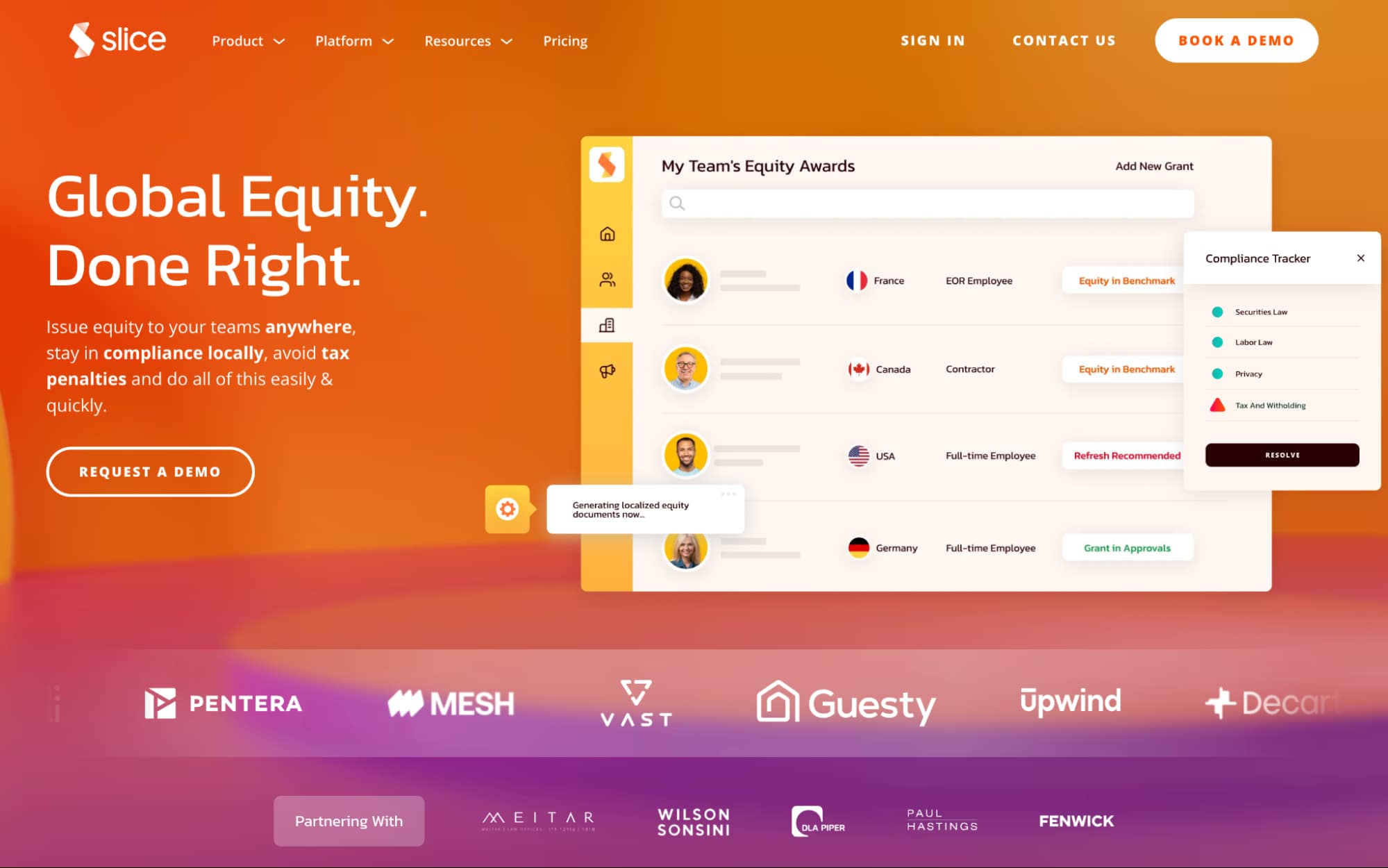
Slice is the AI-native global equity management and compliance platform: cap table, grants, exercises, compliance, SBC and tax reporting in one system. It is the only platform on this list where AI and compliance are built into the workflow itself rather than bolted on afterward. Every grant, exercise, and new hire is checked against local law in real time across more than 60 countries, so exposure is prevented ahead of time rather than discovered when it’s too late.
Slice is for you if:
- You grant equity in two or more countries and want compliance built in, not billed by outside counsel.
- Finance, Legal, and HR need one agentic workflow off a single source of truth, automatically synced with your HRIS.
- You want stock-based compensation and tax reporting produced from the same record that holds every grant and exercise, instead of rebuilt by hand each quarter.
- You want to easily facilitate tender offers and secondary transactions.
Slice is not for you if:
- You want a plain cap table record and nothing more.
- Your entire team sits in one country and you don’t need to track compliance.
- You only need investor-side tooling such as fund administration.
2. Carta
Carta is the largest equity management platform in the US market, covering cap tables, 409A valuations, employee equity plans, fund administration, and liquidity events. US investors, law firms, and auditors treat Carta templates as the default format, while country-specific legal and tax questions are largely left to outside counsel. Carta acquired Capdesk in 2022 and ran it as Carta Europe, and it is now moving those customers onto the main Carta platform. European teams evaluating Carta in 2026 should confirm which platform they will be onboarded to and how their local scheme is supported on it.
Carta is for you if:
- You are US-headquartered and want the stack your investors already work in.
- You need 409A valuations, cap table, and fund administration from one vendor.
- You expect liquidity events such as tender offers handled in-platform.
Carta is not for you if:
- Employees sit across many countries and you want local tax and filing logic in-product.
- You need workflows connecting HR, Legal, and Finance rather than a system of record.
- You only need a cap table, since Carta is priced and built around a much wider suite of products.
3. Ledgy
Ledgy is a Zurich-built equity management platform for European scale-ups, focused on plan automation: cap table, participation plans, employee dashboards, HRIS integrations, and stock-based compensation reporting. It automates plan administration that would otherwise live in spreadsheets.
Ledgy is for you if:
- You are a European scale-up managing plans across several EU entities.
- You want plan administration synced automatically with your HRIS.
- You need stock-based compensation reporting for finance and audit.
Ledgy is not for you if:
- Your footprint extends beyond Europe and needs global tax logic.
- You want compliance monitoring and remediation, not record automation.
- You are a US-first company whose investors expect a US-native platform.
4. Eqvista
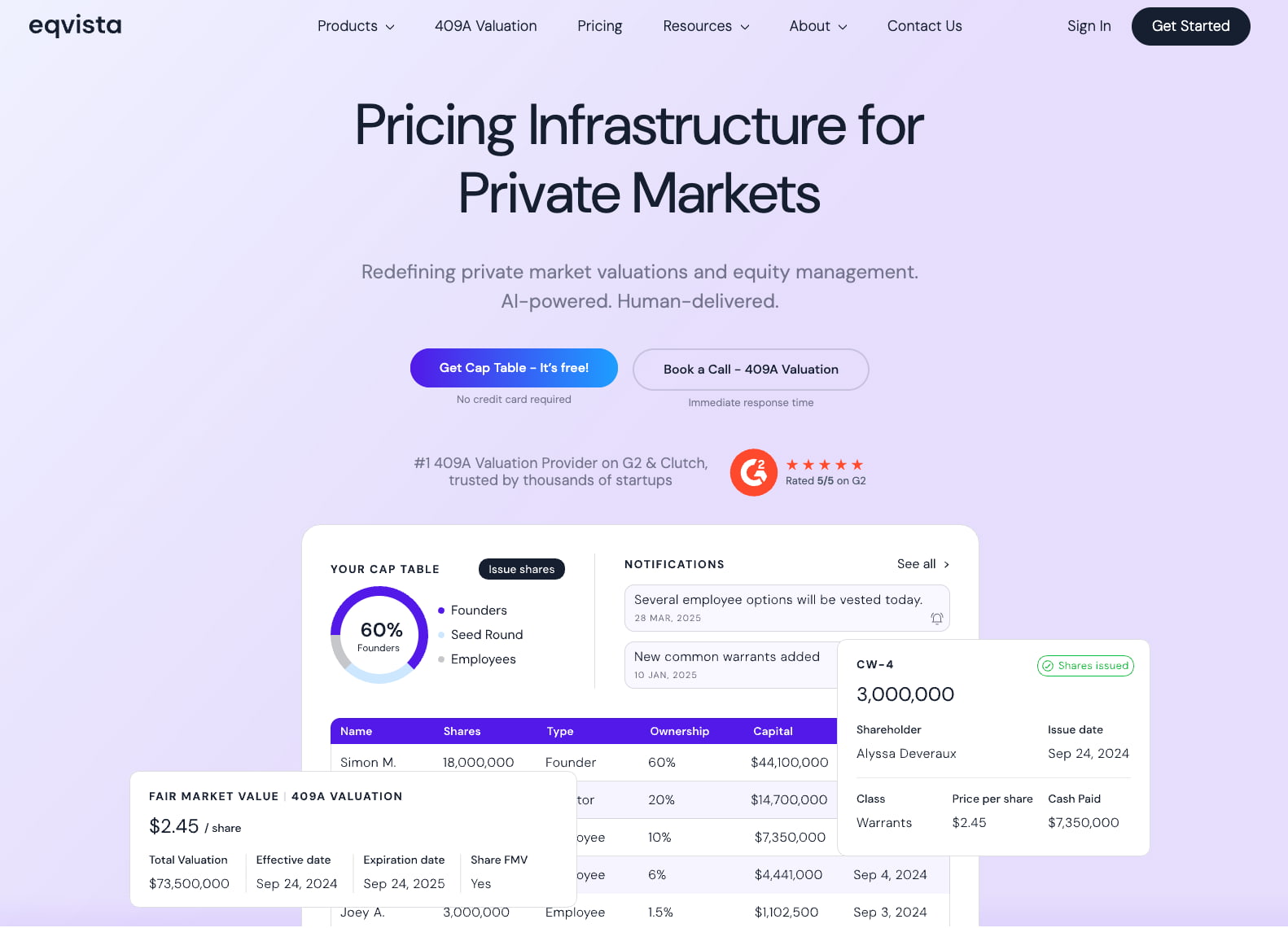
Eqvista is a US equity management and valuation platform covering cap tables, vesting schedules, shareholder accounts, board resolutions, and 409A valuations produced by its own in-house certified analysts. The valuation practice is the center of the product, and the equity record is built around it.
Eqvista is for you if:
- You are a US company that needs an audit-ready 409A valuation and the cap table from one vendor.
- You want transparent per-stakeholder pricing rather than a bundled enterprise suite.
- You issue equity in one country and want the record and the valuation to agree.
Eqvista is not for you if:
- You employ people outside the US and need grants treated correctly under local law.
- You are past the stage where the cap table is the hard part of equity.
- You want equity workflows connecting HR, Legal, and Finance rather than valuation-led record-keeping.
5. Vestd
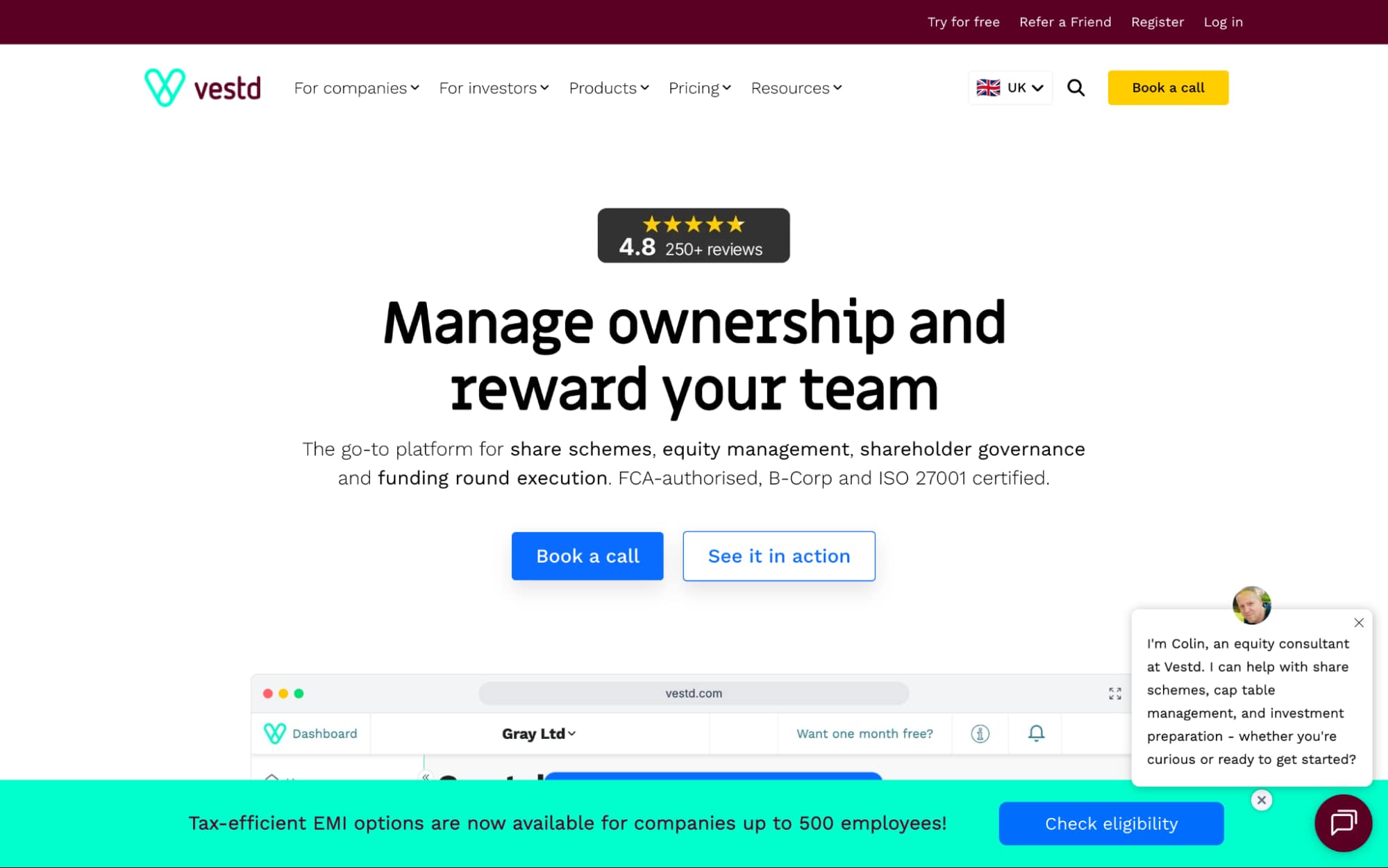
Vestd is a UK share scheme platform for small and mid-sized businesses. It comes with guided end-to-end setup of EMI schemes, growth shares, and agile partnerships, with legal documents and HMRC valuations included.
Vestd is for you if:
- You are a UK-registered SMB setting up your first EMI or growth share scheme.
- You want scheme design, legal documents, and valuations in one guided flow.
- You prefer a fixed-scope UK product over an international platform.
Vestd is not for you if:
- You grant equity to employees outside the UK.
- You are a US-parented company extending a US plan into the UK.
- You expect to scale into a multi-entity, multi-country structure soon.
ESOP Management Software Comparison Overview
The biggest differences between these platforms become clear when you compare jurisdiction coverage, core strength, and target company stage side by side.
What an Ideal ESOP Management Software Needs to Cover
A global ESOP platform should do more than record grants and calculate vesting. It needs to manage the operational, tax, and compliance work that follows equity across countries.
- Automated Vesting Schedules Across Time-Based, Cliff, and Milestone Structures. The platform should compute vesting automatically for every structure the plan uses.
- Employee Portal With Real-Time Visibility Into Granted, Vested, and Exercisable Options. Employees who cannot see what they hold flood HR with tickets.
- Cap Table Sync That Models Dilution and Equity Pool Utilization Accurately. Every grant, exercise, and cancellation should update the pool instantly.
- Continuous Compliance Monitoring Across Every Country Where Employees Hold Options. Rules change and employees relocate, so compliance has to be a standing check, not an annual review.
- Automated Tax Optimization That Captures Local Tax Breaks Before the Deadline Passes. Local regimes apply only if conditions are met on time, and missing a window is usually irreversible.
- Audit Trails and Grant Letter Automation for Board Approvals and Regulatory Filings. Every action needs a record of who approved what and when.
How to Choose the Right ESOP Management Software for Your Company
Evaluation means matching the platform to your footprint. Five steps keep it honest, and the table turns them into vendor questions.
How Slice Global Equity Keeps ESOP Grants Compliant Across 60+ Countries
Slice approaches the problem from the compliance side rather than the record-keeping side, which is what makes it the ideal platform built for global teams.
- Continuous Global Compliance With Preemptive Alerts Before Exposure Issues Arise: The built-in global compliance engine checks every grant, exercise, and hire against local law in real time, raising an alert before the exposure exists.
- Automated Tax Optimization for Every Grant Type Across Every Jurisdiction: Slice maps each grant to the local regime it can qualify for and tracks the conditions, so tax breaks are captured before deadlines pass.
- Instant Detection and Remediation of Equity Exposure Across the Plan: When a rule changes or an employee relocates mid-vesting, Slice identifies which grants are affected and what fixes them.
- Country-Specific Grant Letters, Templates, and Reporting Generated Automatically: Grant letters and reports come out in the form each jurisdiction expects, without a law firm drafting each one.
- Secure Equity Lifecycle Automation With Full Audit Trails Across Every Action: SliceAI, a single secured agent inside the platform, runs planning and reporting on demand. Sensitive cap table data never leaves the platform.
Conclusion
The ESOP management software market in 2026 is genuinely good at record-keeping, and Carta, Ledgy, Eqvista, and Vestd each serve their home segment well. The unsolved problem is the global one: equity has shifted from record-keeping to regulatory infrastructure, and a plan spanning five countries needs software that knows the law in all five.
That is the case Slice was built for. The AI-native global equity management and compliance platform checks every grant, exercise, and hire against local law in real time across 60+ countries, and goes live in about two weeks. If your next hires are in new countries, see how Slice keeps global equity compliant before the first grant goes out.
Gal Acrich is an accomplished lawyer and accountant specializing in technology and equity management. Holding dual Bachelor’s degrees in Law and Business/Management, Gal currently leads Business Development & Compliance at Slice. This role involves navigating complex international equity regulations and tax codes. Previously, Gal served as a Senior Strategy and Transactions Consultant at EY and has substantial legal experience from her time at H-F & Co. Law Offices. Her expertise in blending law, business, and technology makes Gal a pivotal figure in global equity management.


Global Equity Management
Equity Management Platform Migration: How to Move Without Losing Compliance or Data Integrity
An overview of equity management platform migration for finance and legal teams: what drives the move, which records need to be transferred, a four-step approach, common migration pitfalls, a before, during, and after checklist, and an honest reminder that a clean import marks the beginning of the work, not the end.

Global Equity Tax
Employee Stock Options Tax: How Stock Options Are Taxed & What Companies Must Get Right
How employee stock options are taxed at grant, exercise and sale, how incentive and nonstatutory options split at exercise, and how five countries can treat the same grant, with an honest look at why the mechanics stop being simple the moment a second jurisdiction is involved.


Global Equity Tax
RSU Tax: How Restricted Stock Units Are Taxed and What Companies Need to Get Right
A practical breakdown of RSU taxation for finance and legal teams, covering the grant, vesting, and sale lifecycle with real-world calculations, employer withholding obligations across jurisdictions, and the tax implications of employee relocation during the vesting period.
.svg)

