

Product
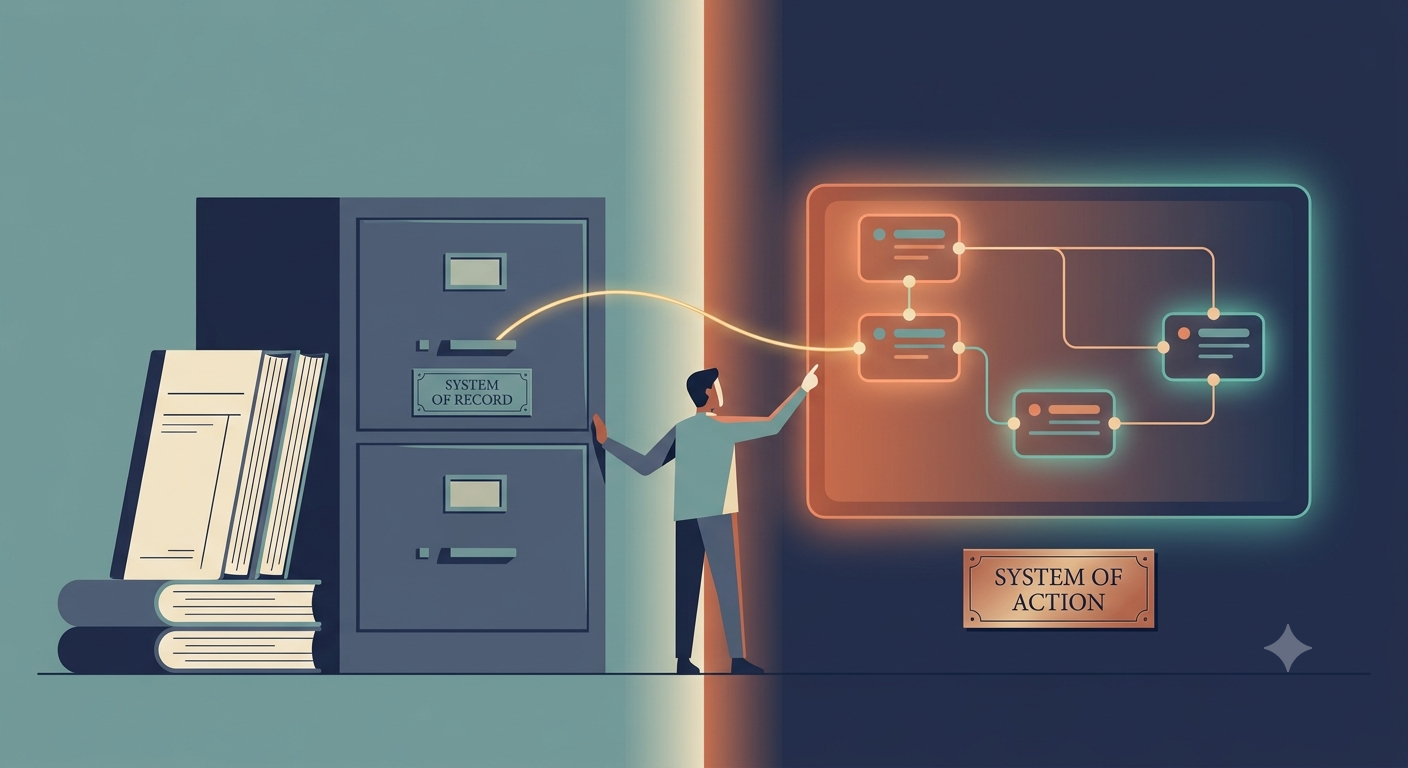
From System of Record to System of Action
Equity platforms were built to remember. Slice is built to act. Here's why a native AI agent - with the platform's data, permissions, and UI inside it - changes what equity software is.

Key Takeaways:
- Equity platforms have always been systems of record - they store what is true. A system of action understands what changed, why it matters, and brings the next step directly to you, through one conversational interface.
- That shift is only possible when the AI is native to the platform: born with access to the data model, the permission matrix, the product's own UI components, and the knowledge base - not a general-purpose chat bolted on through an external connector.
- A system of action changes what it means to use complex software. Instead of becoming an expert in the platform, you work side by side with its best user - with human review and sign-off exactly where it counts.
A System of Record Remembers. A System of Action Moves.
In our latest post, we covered what "AI-native" actually means for equity management - a secured, built-in agent that's three experts in one, already doing real work today. This post is about what all of that makes possible on the surface: the shift from a system that stores your equity to one that acts on it.
For decades, equity software has been a system of record - and a good one earns its keep on fidelity: an accurate cap table, controlled changes, full history, every grant and document in its place. That's real engineering, and it's still the foundation everything else here builds on. But fidelity is also where it stops. When you need something, you go find it: the right screen, the right filter, the right export. The system answers "what is true?" - and everything after that is your job. The truth is in the system; the expertise is in people.
That's not an abstraction. It's what equity teams actually do all day. They interpret events - what does this termination or relocation actually trigger, in which country, by when. They research the rules: an email to outside counsel per jurisdiction, a few thousand dollars, a two-week wait. They reconcile the cap table against grant letters against the HR system against payroll. They track deadlines in spreadsheets and calendar reminders - exercise windows, filings, board approvals, valuation refreshes. And they build the artifacts by hand: board packs, audit binders, DD rooms, exports reshaped in Excel.
A system of action starts from the opposite premise. It understands what changed, what it means, what risk it creates, and what should happen next - and then it brings that next step to you. You don't navigate to the work. The work arrives, explained, with the action attached. Expertise lives in the system; judgment stays with you.
At Slice, the way that happens is through the agent built into the platform. Not a chat window sitting next to the product. The product itself, in conversational form.
A system of record answers "what is true." A system of action answers "what happens next" - and does it with you
Why This Can't Be Bolted On
It's tempting to think any platform can get here by wiring an external AI chat to its API through a connector. That approach gets you something real - a chat that can pull data and answer questions about it. But it's a fundamentally different thing, for three reasons.
- Native access, native capabilities. An external agent sees your platform as a stream of data. Slice AI is part of the platform. It has native access to the full data model and purpose-built capabilities for acting on it - creating, updating, and orchestrating across the same engines the rest of the product runs on. It doesn't approximate what the platform can do from the outside. It does what the platform does, from the inside. Read more about the difference between AI-native equity management’s infrastructure and hype.
- The platform lives inside the chat. Because the agent is native, the chat isn't limited to text. It renders the same themes, the same buttons, and entire live components from the platform directly in the conversation. Review a schedule, approve a workflow, drill into a grant - inside the chat, using the product's own interface. The agent can also follow you through the platform itself, executing on any screen the actions you would otherwise click through by hand. An outside chat can describe your product. A native agent operates it with you.
- The permission model comes built in. This is the part that's nearly impossible to replicate from the outside. Slice's governance model is granular down to individual objects - you can build permission profiles that filter specific grants, specific documents, specific rows of data. The native agent inherits that entire matrix automatically. Every user's chat sees exactly what that user is allowed to see, and can do only what that user is allowed to do. An external connector would need the whole permission matrix faithfully relayed through APIs on every request - a fragile approximation of something that, inside the platform, is simply how the system works. And consistent with how we build everything at Slice: permissions are deterministic. The agent operates inside them, never around them.
One Interface to the Entire Ecosystem
The agent isn't a feature next to the modules. It's the front door to all of them.
The onboarding module ingests a company's historical legal reality - grant letters, board approvals, share certificates, certificates of incorporation, even multiple conflicting cap tables - extracts the data, reconciles it, and surfaces every conflict on the way to a complete, structured picture. The Documents Room then keeps that picture honest: it continuously validates the system of record against the underlying legal documents, so any discrepancy between what the record says and what the paperwork says is surfaced, not buried. The compliance and tax engines sit on top of that validated data and maintain the live compliance picture across every country you operate in.
And alongside the engines sits something an outside chat can never reach: Slice's compliance knowledge base - curated, continuously updated by our team, and full of material that isn't sitting on the public web. When you ask the agent a compliance question, the answer comes with citations. You see where it came from, what the source says, and why. That's a different standard than a confident-sounding web search.
All of it - data, documents, engines, knowledge - is accessible through one conversation, and the agent works the same way every time: detect what changed, interpret what it triggers, prepare the work, execute it with your sign-off.
Here's what that feels like in practice. Someone on the finance team asks: "We're relocating two engineers from the UK to Germany next quarter - what does that change?" The agent pulls their grants, checks the mobility and tax rules on both sides, surfaces the compliance obligations and deadlines the move creates, explains which rules were triggered and why, and lays out the steps - offering to execute each one once a person has reviewed and approved it. What used to be a research project across three teams becomes a conversation with a system that already knows. Read more about what happens to equity when employees move countries.
The same pattern holds for a termination. The moment someone's employment ends, the agent already knows the exercise window just opened, which notices are owed, and which documents need to be generated - and lays out each step for approval before the window closes on its own.
From Learning a Platform to Working With an Expert
There's a hidden cost in every powerful platform: the learning curve. The traditional deal is that the software holds enormous capability, and you unlock it by becoming an expert - learning every screen, every button, every workflow. The more powerful the platform, the steeper the climb.
A system of action breaks that deal. The agent is Slice's best user. It knows the entire landscape of the platform - every module, every feature, every workflow - and its job is to put that at your fingertips. You don't hunt for the right screen; it brings the action to you. You don't take a tutorial; it teaches you as you go. You don't decode what the system did; it explains what changed, what data it used, which rule fired, and what needs your attention.
That's the real meaning of the shift. A system of record makes you come to it, and rewards you for expertise you had to build yourself. A system of action comes to you - and makes the full power of the platform available from the first conversation. You're not learning software anymore. You're working with an expert who happens to be the software.
The Future of Equity Management Is a System of Action
Global equity is one of the hardest domains in software precisely because so much depends on knowing what changed, what it triggers, and who has to act. A system of record can hold all of that. Only a system of action can hand it to you.
That's what we're building at Slice: dozens of engines, a validated record, a living compliance picture, and a curated knowledge base - all behind one interface that understands what you need and brings it to you, with a human signing off where it counts.
If you'd rather work with an expert than learn another platform, book a demo and see it for yourself.
Samuel Amar is Co-Founder and CTO of Slice, where he leads engineering and product architecture behind the platform's deterministic and AI-native systems. Prior to Slice, he worked as a full-stack and blockchain engineer for companies including Cyabra and Papaya Gaming, building systems across decentralized and traditional infrastructure. Samuel holds a B.Sc. in Software Engineering (Cum Laude), with a major in Cyber Security, from the Technion Institute of Technology.


Product
AI That's Built In, Not One You Plug In
Your security concerns about AI and equity data are valid. Here's why a built-in agent - not a connected chat tool - is the only architecture that actually holds up.
.png)

.png)

.svg)
