News
Finance, HR & Legal: The Golden Triangle of Equity Management - And Why Only AI-Native Platforms Can Finally Close It
Finance, HR, and Legal all own part of equity management. Learn how AI-native platforms connect these teams to automate workflows, reduce compliance risk, and eliminate manual coordination.

Something fundamental has shifted in how finance leaders think about equity management. Not just what the platform does, but what it should be capable of.
For years, equity management was treated as a record-keeping problem. You needed a system that could store cap table data, generate grant letters, and produce compliance reports. The market built exactly that: document-heavy, audit-trail-focused platforms designed for a world where a human expert was always in the loop, checking and reconciling across systems.
That world has changed. And the platforms built for it are showing their age.
The question finance leaders are asking today isn't "does this system store our equity data?" It's: "Does this system think about our equity data, and act on it, across every department that touches it?" That is a fundamentally different question. And it's one that only an AI-native equity platform can answer.
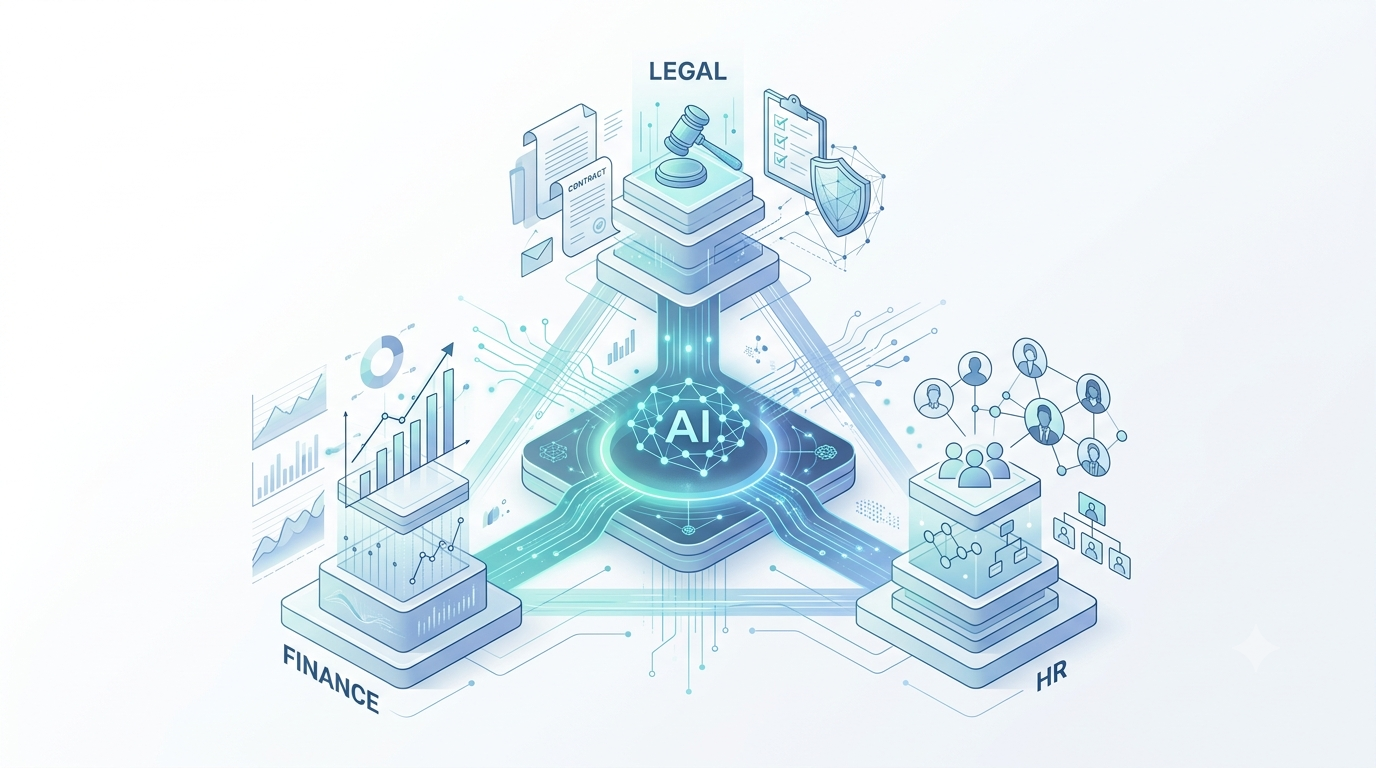
Every company, from a 50-person seed-stage startup to a 5,000-person pre-IPO company, has three departments that share ownership of equity: Finance, HR, and Legal, the Golden Triangle of equity management. But none of these departments have had access to a streamlined way to collaborate on equity management workflows. The complexity of equity management has never really been a Finance problem, an HR problem, or a Legal problem. It has always been a connectivity problem between all three. And that connectivity problem has never been solved - until now.
The Golden Triangle of Equity
Finance holds the numbers: the equity pool, the dilution model, the accounting treatment under US GAAP or IFRS, the scenario analysis for the next funding round. Every equity decision - a new grant, a pool expansion, a refresh cycle - runs through Finance first and last.
HR holds the people: who joined, who left, who moved countries, what role they're in, how their employment is structured. Without accurate, real-time people data, equity data is fiction.
Legal holds the rules: the grant agreements, the board approvals, the country-specific compliance requirements, the filing windows and tax treatment elections that determine whether equity is an asset or a liability for the people receiving it.
These three functions are not just related, they are interdependent. Every equity event simultaneously touches all three. A new hire in Israel isn't just an HR record, it requires Legal to set up a Section 102 trustee structure, and Finance to model the pool impact and accounting treatment. A termination isn't just an offboarding task, it triggers a post-termination exercise period (PTEP) that Legal must document, a pool recapture that Finance must record, and a notification the employee must receive within a precise window. An employee relocating from the UK to Canada mid-vesting isn't just an address change, it fractures the tax treatment of their unvested shares across two jurisdictions, simultaneously requiring both Legal and Finance to recalculate and re-document.
When the three corners of this triangle are aligned, not eventually, not in the weekly sync meeting, but instantaneously and automatically, equity management becomes a competitive advantage. When they aren't, it becomes a source of the kind of surprises that derail IPOs and generate legal claims.
Why the Old Platforms Were Never Built for This
Here is the honest reality about every equity management platform built before the AI era: they were designed around a single department's workflow.
The cap table platforms were built for Finance. The HRIS systems were built for HR. The document management tools were built for Legal. And when those platforms needed to talk to each other, the answer was always the same: an integration that pushed data in one direction, in batch, once a day.
That is not connectivity. That is a slower version of sending a spreadsheet over email.
Consider what "HRIS integration" actually means in practice for most equity platforms today. An employee record syncs from your HR system to your equity platform - name, start date, department, role. Your equity platform now knows that person exists.
But when that employee's country changes in the HRIS at 9am, does the equity platform immediately evaluate the compliance implications of that move, alert Legal, and flag the change in tax treatment for Finance? It does not. Someone, somewhere, will notice the discrepancy in a few days, or a few months, or when the employee exercises their options and discovers a problem that could have been caught on day one.
The reason these platforms can't close the triangle is architectural, not just a matter of missing features. They were built as systems of record. Their job is to store what happened. The AI-native approach is fundamentally different: the platform's job is to act on what happens, the moment it happens, across all three departments simultaneously.
What Incumbents Can't Do (And Why)
Existing equity platforms have tried to solve this problem by adding integrations, adding workflows, adding compliance modules. But you cannot retrofit native intelligence onto a legacy architecture. The connectivity problem requires the AI to be embedded in the infrastructure itself, in the data model, in the event triggers, in the compliance logic, not layered on top as an additional feature.
When a termination event fires, an AI-native platform doesn't wait for a human to open a checklist. It immediately calculates the applicable PTEP window based on the employee's jurisdiction and equity plan type, generates the notice, routes it through the approval workflow, updates the live pool balance, records the change in the audit trail, and alerts Finance to the recaptured units, all before the end of the hour. The three corners of the triangle move together, automatically, because the intelligence driving those workflows was designed to span all three from the start.
Legacy platforms can automate parts of this. They cannot automate the reasoning that connects the HR event to the Legal workflow to the Finance model as a single, continuous process. That requires AI at the infrastructure level. That is what AI-native means.
The Example That Makes This Concrete
Nothing illustrates the gap between the old world and the new one more clearly than equity pool planning.
Every CFO and Head of HR knows this exercise. At least once a year, often every quarter, the company needs to answer five questions together:
- What equity benchmarks are we actually using, by role and seniority level, over the last six months?
- Who is due for a retention refresh, and how much do they each need?
- What does the hiring plan cost in equity, developers, managers, VPs, for the next two quarters?
- What does the pool look like today, and at year-end, after accounting for refreshes, new hires, and terminations?
- Do we need to expand the pool? If so, by how much, and what is the dilution impact?
Under the traditional model, answering these five questions is a weeks-long project. HR exports a spreadsheet. Finance builds a model. Legal pulls grant data from a separate equity system. Everyone reconciles over email. Someone discovers the numbers don't match because the HR export is three days old. External advisors such as a compensation consultant, an equity attorney - get pulled in, each adding time and cost. By the time the output lands in a board deck, the underlying data has already changed.
With Slice’s AI-native platform, these five questions are a single prompt. The platform has live access to HR data, equity pool data, and grant history simultaneously. It benchmarks grants against actual historical data, builds the refresh list based on the policy you define, models the hiring plan against the real pool balance, projects year-end availability after terminations, and tells you whether you need to expand the pool and by exactly how much, in minutes.
Finance gets the numbers. HR gets the refresh list. Legal gets the compliance check built into the output. Not in three separate deliverables produced over three weeks, but from one AI-agent, against one live source of truth, in the time it takes to describe what you need.
This is not a better version of the old workflow. It is the elimination of the old workflow.
The New Standard for Finance Leaders
The finance leaders who are moving fastest in the AI era are not asking "which equity platform has the best cap table features?" They are asking a different question: "Which platform was actually built for a world where AI runs the workflow, not just assists it?"
That distinction matters because the problems equity management generates are not spreadsheet problems or document problems. They are coordination problems. A $1.5 million tax liability from a mismanaged CSOP exercise window is a coordination failure, Legal didn't know what Finance approved, and neither knew what HR had on file. An IPO delayed six months because of unrecorded tax withholding obligations in India is a coordination failure. A $2 million employee claim from an EOR arrangement that disqualified someone from standard tax treatment is a coordination failure.
These failures happen when the Golden Triangle has gaps. They happen when the equity platform is a system of record for one department, and the other two are working from exports and email threads.
The AI-native equity platform closes those gaps, not by adding better exports, but by eliminating the need for them. When Finance, HR, and Legal all operate through a single intelligent layer that acts on events as they happen, the triangle is no longer a liability. It becomes the architecture of how equity-driven companies operate at the speed the AI era demands.
What This Means for How You Evaluate Equity Platforms
If you are evaluating equity management platforms today, the question to ask is not whether the platform integrates with your HRIS. Every platform claims that. Ask instead: what happens the moment an employee record changes in your HR system?
Does the equity platform automatically evaluate the compliance implications for Legal? Does it instantly update the pool model for Finance? Does it trigger the right document workflow for the employee's specific country, employment type, and equity plan, without a human manually connecting those steps?
If the answer is no, or "we have a workflow and a spreadsheet for that," you are looking at a platform designed for the previous era. The coordination problem at the center of equity management has been solved - but only by platforms built from the beginning with AI as the infrastructure, not the add-on.
The Golden Triangle has three corners. It only works when all three close at the same time. That is what AI-native means in practice. And it is the only standard worth building your equity operations on.
Maor is a Co-founder & the CEO of Slice. He has 13+ years of Legal experience in the Tech world. Prior to Slice, he was a senior partner in HF, a tier-1 Tech law firm, where he represented startups, VCs, and senior executives in a wide range of issues and deals (fundraising, M&As and IPOs). He was ranked 4 years in a row as a Top Tech Attorney by Legal 500. Maor holds an LLM and a BA (both cum laude) from Reichman University.


UK
UK ERS Filing: What Every Company With a UK Share Scheme Needs to Know Before 6 July, 2026
Learn what counts as a reportable ERS event, why nil returns are still required, and the risks of missing HMRC’s annual filing deadline for CSOP, EMI, and other UK share schemes.


.svg)